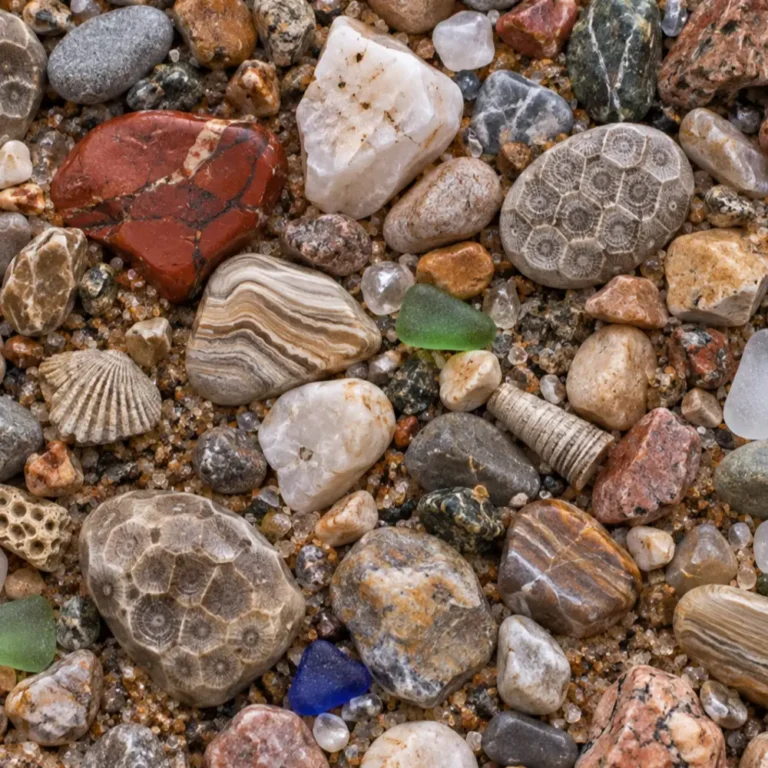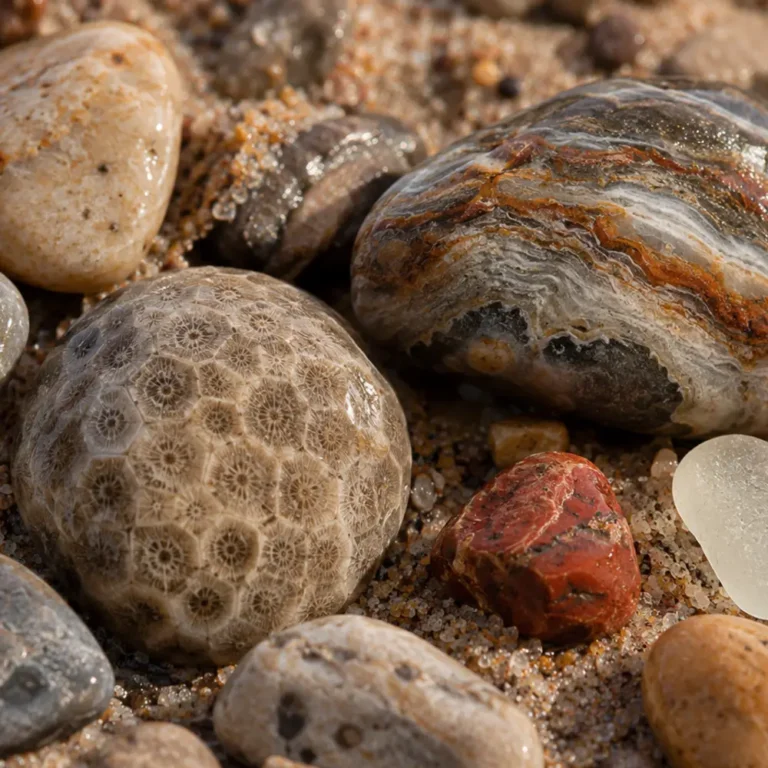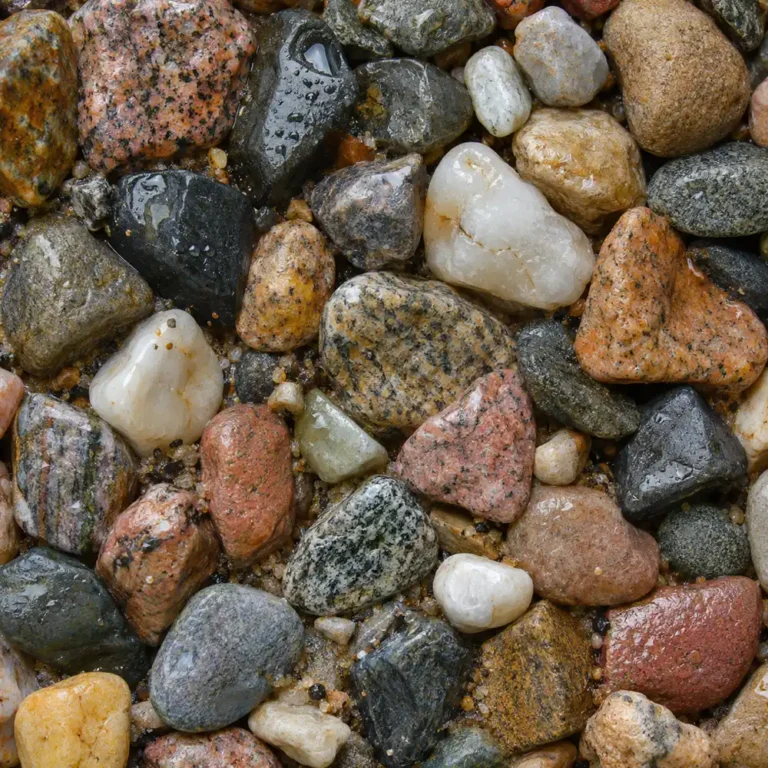
Lake Erie is the beach glass capital of the Great Lakes, and its shale cliffs and limestone islands hold Devonian fossils. The best-known beach glass areas are Presque Isle in Erie, Pennsylvania, and Ohio beaches such as Conneaut, Huntington and Edgewater in Cleveland. Before you pocket anything, know that Ohio and Pennsylvania state park rules prohibit removing rocks and natural objects without permission.
| What you can find | What it is | Where |
|---|---|---|
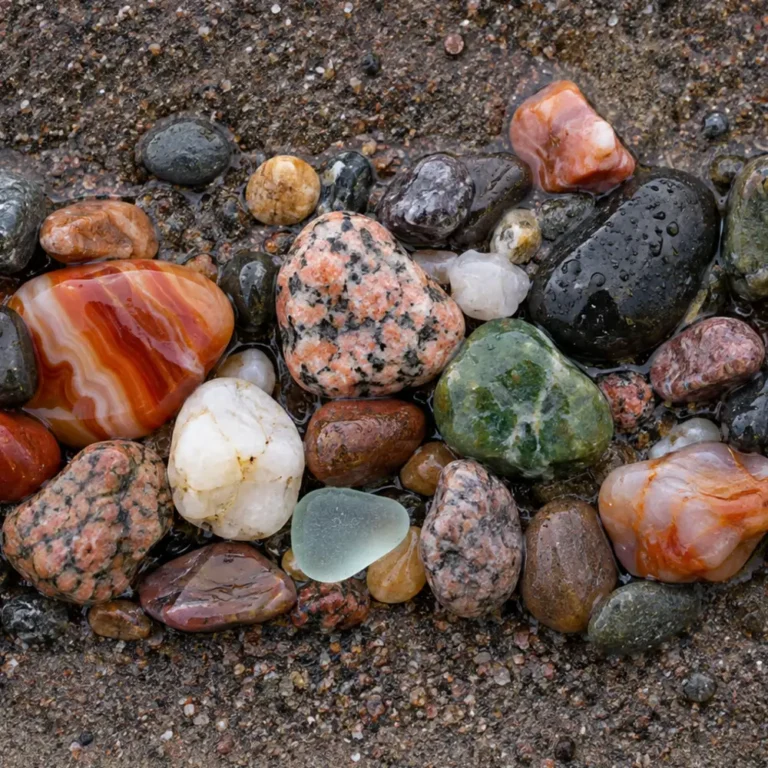
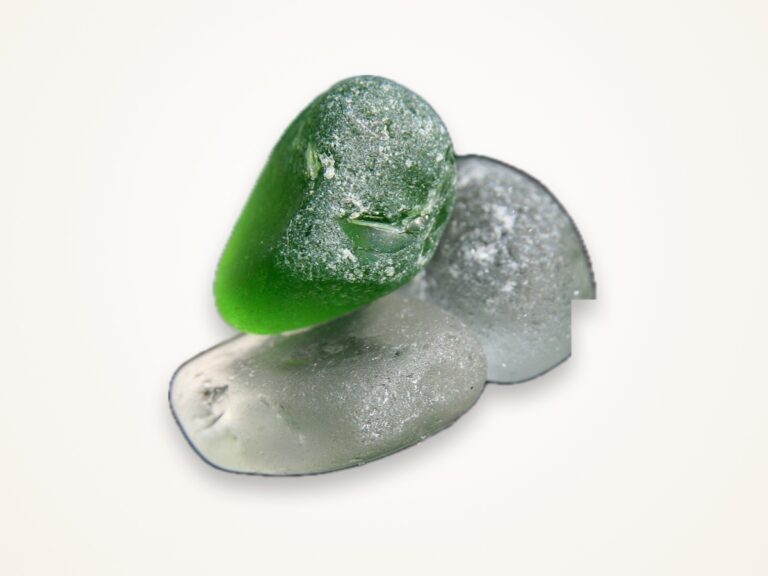
| Beach glass | Old glass smoothed and frosted by the waves | Pennsylvania and Ohio shores, especially after storms |
| Devonian fossils (brachiopods, crinoids, corals) | Fossils from seas about 360–390 million years old | Limestone of the Lake Erie islands; shale along the south shore |
| Glacial stones | Granite, basalt and other rocks carried from Canada | Beaches and bluffs along the whole shore |
| Glacial grooves (to look at, not collect) | Grooves carved in limestone by glaciers | Kelleys Island, Ohio |
Why Lake Erie is different
Lake Erie is the shallowest of the Great Lakes, and its shores are mostly made of soft rocks and glacial deposits:
- Devonian shale forms much of the south shore: the Ohio Shale outcrops from Ashtabula west along Lake Erie to Milan, and the bluffs in Pennsylvania are glacial till sitting on Devonian shale.
- Fossil-rich limestone (the Columbus and Delaware limestones) reaches out to the Lake Erie islands.
- Presque Isle, in Erie, Pennsylvania, is a curved sand-and-gravel spit shaped by waves.
Because of its long industrial and shipping history, Lake Erie’s shoreline has also collected a lot of old glass, which the waves have been turning into beach glass for decades.
Where to look
Pennsylvania: Presque Isle and Erie
Presque Isle State Park’s beaches (Beaches 1 to 3) are among the most popular beach glass spots on the lake. They’re heavily searched, so go early, after a storm or in the off-season. Remember that Pennsylvania state park rules prohibit removing natural objects without permission (see below).
Ohio: Conneaut, Cleveland and the islands
Beach glass hunters name Conneaut, Huntington and Edgewater (Cleveland) among their favorite beaches. The Lake Erie islands sit on fossil-rich limestone. On Kelleys Island, the Glacial Grooves are a state memorial where collecting isn’t allowed: they’re for looking, not taking.
New York: Lake Erie’s eastern end
New York’s Lake Erie shore has Devonian shale with fossils, for example near the mouth of Eighteen Mile Creek. For a guaranteed fossil hunt, Penn Dixie Fossil Park in Hamburg, New York, lets visitors collect and keep Devonian fossils for a fee.
When to go
- After storms, when the waves are kicking up, new glass and stones wash in.
- Early in the morning, before other collectors.
- In the off-season: fall and winter are favorites for dedicated beach glass hunters.
Can you collect on Lake Erie?
Lake Erie has some of the strictest rules on the Great Lakes.
| Where | What the rules say |
|---|---|
| Ohio state parks | Ohio’s rule makes it unlawful to “destroy, disturb, deface, mutilate, or remove earth, sand, gravel,” including stone and rocks from the lake shoreline, except where the state has posted permission to collect (Ohio Admin. Code 1501:46-3-11) |
| Pennsylvania state parks (e.g., Presque Isle) | Removing “rock, shale, sand, clay, soil or other mineral product, natural object or material” requires written permission from DCNR (17 Pa. Code § 11.211) |
| New York state lands (DEC) | “Removing plants, rocks, fossils or artifacts from state land without a permit is illegal” |
| Kelleys Island Glacial Grooves | No collecting |
| Penn Dixie Fossil Park (NY) | Collecting allowed, fee site |
| Private beaches | Only with the owner’s permission |
What about beach glass? None of these rules mentions man-made glass specifically. Some park staff treat old glass as litter; others don’t allow taking anything. Ask the park office before you collect. See our full rock collecting rules.
Frequently asked questions
Where is the best beach glass on Lake Erie?
Presque Isle in Erie, Pennsylvania, and Ohio beaches such as Conneaut, Huntington and Edgewater in Cleveland are the best known. Go after storms and early in the morning.
Can you take rocks from Lake Erie beaches?
Not from Ohio or Pennsylvania state parks without permission: both states’ rules prohibit removing rocks and natural objects. On private beaches, ask the owner.
Are there fossils on Lake Erie?
Yes. Devonian fossils such as brachiopods, crinoids and corals occur in the limestone of the Lake Erie islands and in the shale along the south shore. Penn Dixie Fossil Park in New York is a dedicated fossil-collecting site.
Why is Lake Erie known for beach glass?
A long history of industry, shipping and shoreline dumping put a lot of glass in the lake, and its waves have been smoothing it for decades.
Explore more
- Beach glass on the Great Lakes
- Lake Ontario rocks
- Lake Huron rocks
- Rock collecting rules
- Other Great Lakes: Lake Superior, Lake Michigan, Lake Huron, Lake Ontario
- Rockhounding by state: Ohio, Michigan
Sources (10)
- Ohio Administrative Code 1501:46-3-11: https://www.law.cornell.edu/regulations/ohio/Ohio-Admin-Code-1501-46-3-11
- 17 Pa. Code § 11.211 (Pennsylvania state parks): https://www.law.cornell.edu/regulations/pennsylvania/17-Pa-Code-SS-11-211
- Ohio DNR, Division of Geological Survey, GeoFacts 17 (fossil collecting in Ohio): https://dam.assets.ohio.gov/image/upload/ohiodnr.gov/documents/geology/GF17_Shrake_2014.pdf
- Ohio DNR, GeoFacts 36 (Glacial Grooves, Kelleys Island, 2022): https://dam.assets.ohio.gov/image/upload/ohiodnr.gov/documents/geology/GF36_Peter_2022.pdf
- U.S. Geological Survey, Open-File Report 2009-1042 (Lake Erie shoreline geology): https://pubs.usgs.gov/of/2009/1042/html/geology.html
- New York State DEC, State Land Rules: https://dec.ny.gov/things-to-do/camping/state-land-rules
- New York State DEC, Mouth of Eighteen Mile Creek at Lake Erie: https://dec.ny.gov/mouth-of-eighteen-mile-creek-at-lake-erie
- Penn Dixie Fossil Park & Nature Reserve: https://penndixie.org/fossil-hunting/
- The Allegheny Front, “How to find beach glass on Lake Erie” (2026): https://www.alleghenyfront.org/how-to-find-beach-glass-lake-erie/
- Photo credits (via Wikimedia Commons; some backgrounds removed): Larsgl (public domain); James St. John (CC BY 2.0).
Last updated: November 29, 2026. Spotted something out of date? Tell us.