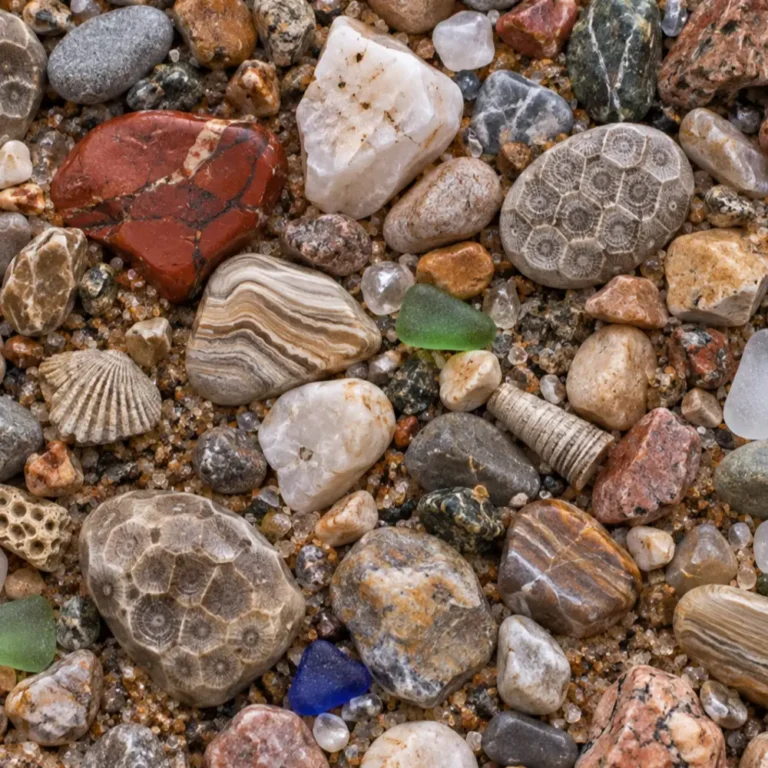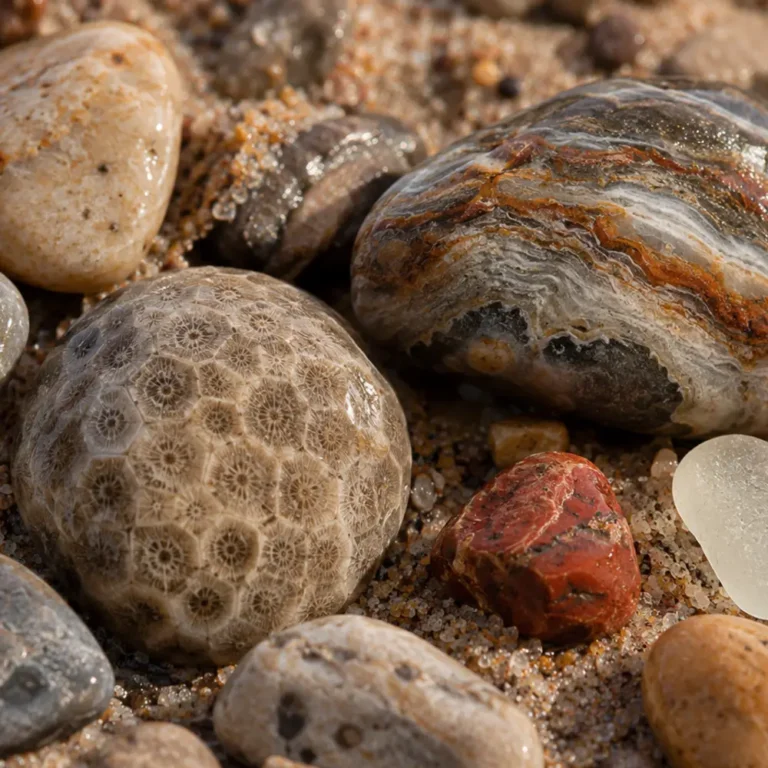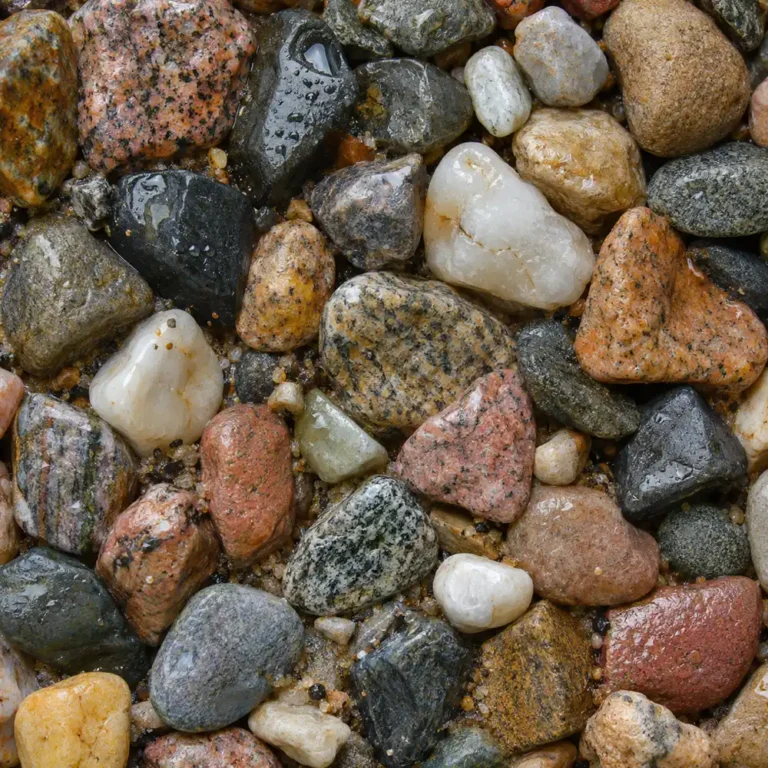
Wisconsin has two Great Lakes and two kinds of rock hunting: Lake Superior agates in the north, and fossil corals on the Lake Michigan shore, especially around Door County. Since August 2024, Wisconsin’s rules allow hobby collecting on many state properties, but only with the written permission of the property manager. Collecting is not allowed in Apostle Islands National Lakeshore.
| Wisconsin’s official symbols | |
|---|---|
| State rock | Red granite (1971) |
| State mineral | Galena (1971) |
| State fossil | Trilobite Calymene celebra (1985) |
What can you find in Wisconsin?
| Find | What it is | Where |
|---|---|---|
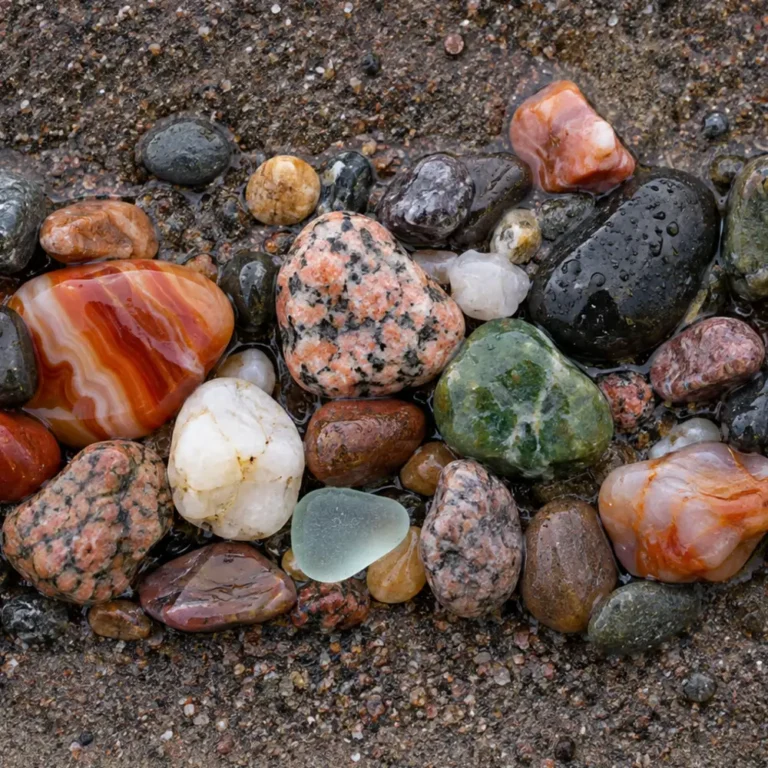
| Lake Superior agate | Banded red, orange and white chalcedony | Lake Superior beaches and gravel pits in the north (Ashland County and around), plus gravel pits in many western counties |
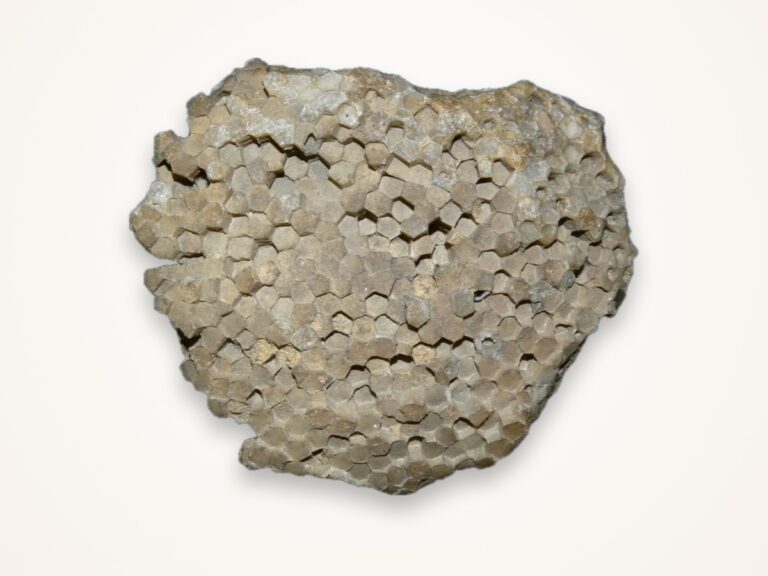
| Fossil corals (Favosites, Halysites) | Honeycomb and chain corals from ancient Silurian reefs | Lake Michigan beach pebbles and gravel, Door County |
| Fossil shells | Brachiopods and other shells | Door County Peninsula |
| Beach glass | Old glass smoothed by the waves | Beaches near towns and harbors |
Where to look in Wisconsin
Lake Superior: agates in the north
The Wisconsin Geological and Natural History Survey lists agates in Ashland County “gravel pits … as well as along beaches.” Agates also turn up in gravel pits across many other counties, including Chippewa, Dunn, Pepin, Washburn, Pierce and St. Croix, because glaciers spread them south and west. Gravel pits are private: ask permission.
Apostle Islands National Lakeshore has agates on its beaches, but collecting rocks there is not allowed.
Lake Michigan: fossil corals and Door County
Wisconsin’s Lake Michigan shore sits on Silurian dolomite, the rock of the Niagara Escarpment, built from ancient coral reefs. The state survey notes that “beach pebbles and gravel along the Lake Michigan shoreline also abound with coral fragments,” mainly honeycomb (Favosites) and chain (Halysites) corals. The Wisconsin DNR invites visitors to “look for fossil seashells and coral reefs” throughout the Door County Peninsula.
When to go
- Spring and after storms on the Lake Superior beaches, for fresh agates.
- After high water in gravel pits and on riverbanks.
- Calm, low-water days on Lake Michigan, when fossil-rich pebble beds are exposed.
What are the rules for rock collecting in Wisconsin?
| Where | Can you collect? |
|---|---|
| State properties (parks, forests and other DNR lands) | Only with written permission from the property manager. Hobby collecting by hand or with a hand-held rock hammer, non-commercial, up to 5 lb per day and 50 lb per year (rules in effect since August 1, 2024) |
| State trails and Havenwoods State Forest | No, collecting is entirely prohibited |
| Designated non-collection sites | No |
| State Natural Areas | Only with a scientific collector permit |
| Apostle Islands National Lakeshore | No. “Collecting other natural objects such as rocks … is not allowed” |
| Chequamegon-Nicolet National Forest | Generally yes, small amounts for personal use under federal rules. Check with the ranger district |
| Gravel pits and private land | Only with the owner’s permission |
Heads up: many older guides say collecting is banned in all Wisconsin state parks. That was true before the 2024 rule change. Today it’s possible, but only with written permission. See our full guide to rock collecting rules.
Frequently asked questions
Can you find Lake Superior agates in Wisconsin?
Yes, on Lake Superior beaches and in gravel pits in the north, and in gravel pits across many western counties. Not in Apostle Islands National Lakeshore, where collecting is prohibited.
Can you collect rocks in Wisconsin state parks?
Since August 2024, yes in many cases, but only with the property manager’s written permission, by hand or with a hand-held rock hammer, up to 5 lb per day and 50 lb per year. It’s never allowed on state trails or designated non-collection sites.
Where can you find fossils in Wisconsin?
On Lake Michigan’s shore, especially in Door County, where beach pebbles are full of fossil coral fragments.
What is Wisconsin’s state rock?
Red granite, designated in 1971. Galena is the state mineral, and the trilobite Calymene celebra is the state fossil.
Related guides
Sources (10)
- Wisconsin Geological and Natural History Survey, Quartz (agate localities): https://home.wgnhs.wisc.edu/minerals/quartz/
- Wisconsin Geological and Natural History Survey, Corals: https://home.wgnhs.wisc.edu/wisconsin-geology/fossils/corals/
- Wisconsin Geological and Natural History Survey, red granite (state rock): https://home.wgnhs.wisc.edu/how-to-identify-red-granite-wisconsin-state-rock/
- Wisconsin DNR, Picking and gathering on state properties: https://dnr.wisconsin.gov/topic/parks/rules/gathering
- Wisconsin DNR, Whitefish Dunes State Park geology: https://dnr.wisconsin.gov/topic/parks/whitefish/geology
- Wisconsin Administrative Code NR 45.04(1s), as amended by CR 23-060 (effective August 1, 2024): https://docs.legis.wisconsin.gov/code/chr/all/cr_23_060
- 1985 Wisconsin Act 162 (state fossil): https://docs.legis.wisconsin.gov/1985/related/acts/162
- National Park Service, Apostle Islands, Leave No Trace: https://www.nps.gov/apis/planyourvisit/leavenotrace.htm
- USDA Forest Service, Chequamegon-Nicolet National Forest: https://www.fs.usda.gov/r09/chequamegon-nicolet/recreation/opportunities/other
- Photo credits (via Wikimedia Commons; some backgrounds removed): Wilson44691 (public domain).
Last updated: November 29, 2026. Spotted something out of date? Tell us.