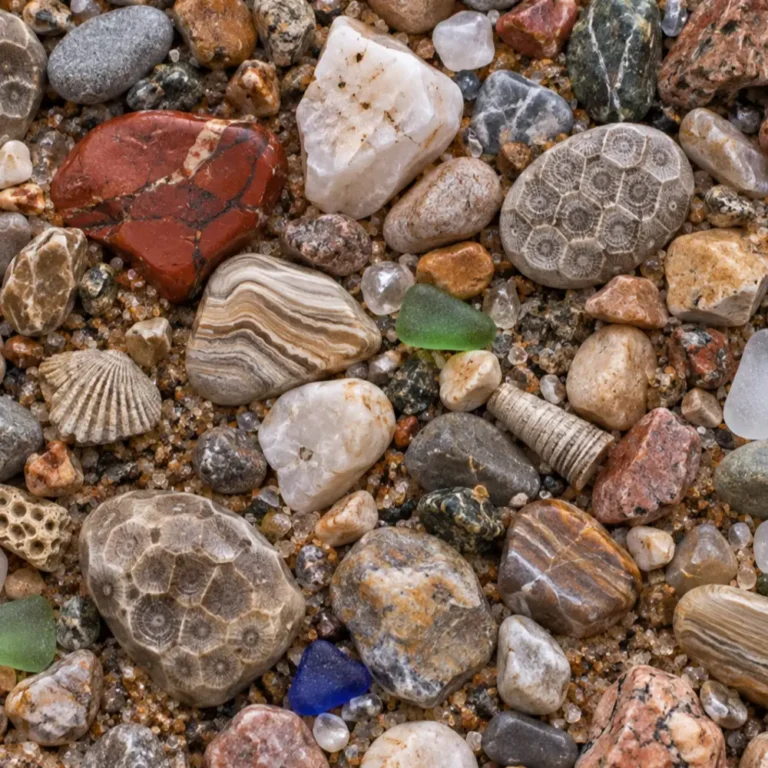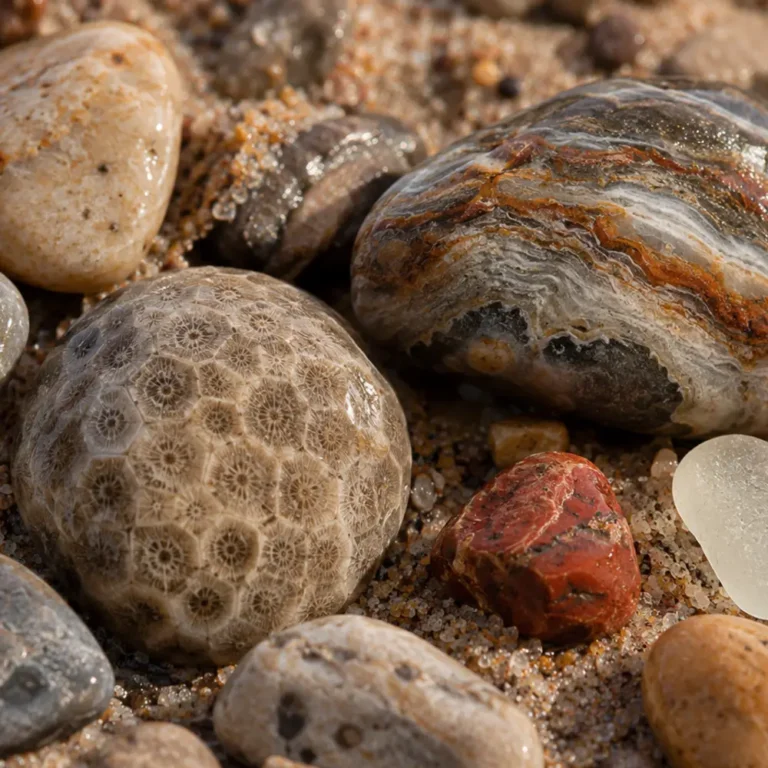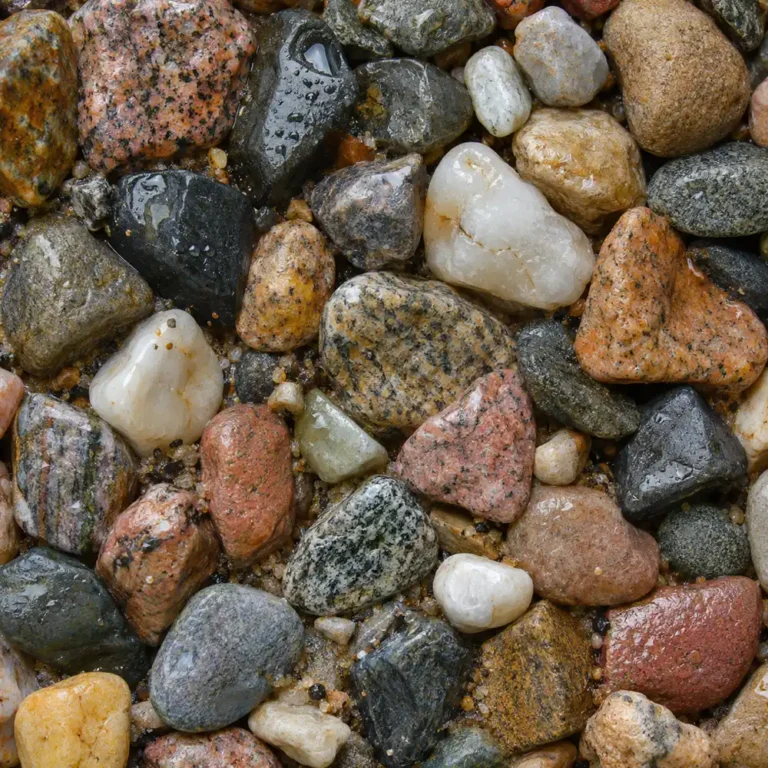
Leland Blue is not a natural stone: it’s slag, a glassy waste product left by an iron furnace that ran in Leland, Michigan, from 1870 into the mid-1880s. The slag was dumped into Lake Michigan and used as fill, and the waves have been washing it back onto the beaches around Leland ever since. Look for smooth, glassy pieces in robin’s-egg blue, gray, green or purple, often dotted with tiny bubbles.
| Quick facts | |
|---|---|
| What it is | Slag glass, a by-product of iron smelting |
| Where it came from | The iron furnace in Leland, Michigan (Leelanau Peninsula) |
| When it was made | 1870 to the mid-1880s |
| Colors | Mostly light blue; also gray, green, teal and purple |
| Key feature | Glassy surface with small round gas bubbles and pits |
| Where to look | Lake Michigan beaches in and around Leland |
| Best season | Off-season (October to April); fewer hunters, bigger pieces |
What is Leland Blue?
In 1870, Leland became the Lake Michigan port for an iron smelting furnace. The company, known as the Leland Lake Superior Iron Company, shipped in iron ore from Michigan’s Upper Peninsula and burned charcoal made from local maple and beech in large kilns. At its peak, the furnace could produce up to 40 tons of iron a day.
Smelting iron leaves behind slag: the melted impurities that separate from the iron. In Leland, that slag cooled into a glassy, often blue material. The business struggled with high costs and the lack of a good harbor, and it closed in the mid-1880s (sources give 1884 or 1885). Its slag heaps were used as fill and dumped into Lake Michigan.
More than 140 years later, the lake keeps tumbling those pieces and returning them to the shore, smoothed like beach glass. Locals call them Leland Blues, and they’ve become one of the Leelanau Peninsula’s best-known beach finds.
Why is it blue?
Nobody has a single, settled answer. Sources agree that the color depends on the chemistry of each batch: the impurities in the iron ore, the furnace temperature and how much oxygen was in the fire. That’s why Leland Blue isn’t always blue. Gray, green, teal and purple pieces come from the same furnace.
How do you identify Leland Blue?
Look for these signs:
- Glassy luster, like thick, cloudy glass rather than a rough rock.
- Round gas bubbles inside the piece and small pits on the surface, left by gas trapped as the slag cooled.
- Swirls or flow bands of color.
- Curved, shell-like breaks on broken edges, like broken glass.
- Color: most often light “robin’s egg” blue, but also gray, green, teal or purple.
Leland Blue vs. beach glass, chert and other slag
| Find | How to tell it apart from Leland Blue |
|---|---|
| Beach glass | Comes from bottles: thin, even thickness, frosted all over, few or no bubbles |
| Chert | A natural rock: no trapped gas bubbles, duller surface, usually not translucent |
| Basalt | Dark, heavy volcanic rock with no glassy luster |
| Frankfort Green | Slag from the old iron works at Frankfort, Michigan, often green. Same kind of material, different town |
| Elk Rapids slag | Slag from the Elk Rapids iron works, often gray with some blue |
Strictly speaking, “Leland Blue” means slag from the Leland furnace. Similar slag found near other old iron towns is usually named after that town. If you buy a piece, ask where it was found.
Where can you find Leland Blue?
Leland Blue turns up mostly on the Lake Michigan beaches in and around the village of Leland, where the furnace stood. It appears in pockets rather than evenly along the whole shore.
Places people commonly search:
- Van’s Beach, a public beach at the end of Cedar Street in downtown Leland, and the best-known spot.
- North Beach (also called Miller Beach), just north of the harbor and Fishtown, at the end of North Street.
- The shoreline near the harbor and Fishtown.
- South Beach, on the other side of town.
When is the best time to look?
The off-season, roughly October to April, is the best time to find bigger pieces: the waves have had time to bring up new material, and there are far fewer people on the beach. Summer beaches near Leland get picked over quickly.
Walk slowly along the waterline and scan for a flash of blue among the wet pebbles. Wet pieces show their color much better than dry ones.
Don’t be surprised if you come home empty-handed: Leland Blue turns up in pockets, and the beaches in town are popular in summer. Some visitors find nothing on their first try. Come back in the off-season or after a storm.
Is it legal to collect Leland Blue?
Generally yes on Leland’s public beaches, but check the posted rules. We haven’t found any rule specific to Leland Blue. Here is what applies:
| Where | What to know |
|---|---|
| Public beaches in Leland (Van’s Beach, North Beach) | Public access. We found no specific ban on picking up slag, but local rules can change: follow any posted signs |
| Private shoreline | Only with the owner’s permission |
| Sleeping Bear Dunes National Lakeshore (south of Leland, e.g. Good Harbor Bay) | No collecting. Removing anything from the National Lakeshore is illegal under federal law |
| Michigan state land | State rules limit collecting to 25 lb per person per year of rocks, minerals and invertebrate fossils. Whether man-made slag counts isn’t spelled out, so stay well under it |
Take only what you’ll keep, and leave plenty for the next person. See our rock collecting rules for the details.
Is Leland Blue worth anything?
Yes, to collectors and jewelry makers. Value depends on:
- Color: bright, clear blues are the most sought after; gray and dark pieces are worth less.
- Size and condition: larger pieces with few cracks bring more.
- Origin: pieces with a clear Leland origin are valued more than unlabeled “blue slag.”
Rock Seeker reports that high-quality raw blue slag can sell for as much as $100 per pound. Most beach-found pieces are small and worth far less: their real value is the story behind them.
Local jewelers often set Leland Blue in its natural shape, because it’s brittle and tends to fracture when cut.
Can you polish Leland Blue?
Yes, but carefully. Slag is brittle and often has internal cracks and bubbles, so it can chip or break when ground or cut. Many collectors keep beach-smoothed pieces as they are, or have them set as-is in jewelry.
Frequently asked questions
Is Leland Blue a real stone?
No. It’s man-made slag glass from iron smelting. It looks like a stone after years of tumbling in the lake, which is why people call it Leland Blue “stone.”
Is Leland Blue a natural stone?
No, and it’s one of the most common misconceptions. It’s slag from Leland’s 19th-century iron furnace, smoothed by the lake.
Is Leland Blue the same as beach glass?
No. Beach glass comes from bottles and other glass objects. Leland Blue is furnace slag, usually thicker, full of gas bubbles, and with swirls of color.
How old is Leland Blue?
It was made between 1870 and the mid-1880s, when the Leland iron furnace operated.
Can you find Leland Blue anywhere else?
“Leland Blue” refers to slag from Leland’s furnace, so you’ll find it mostly around Leland. Other Michigan iron towns, such as Frankfort and Elk Rapids, left their own slag, usually named after those towns.
What color is Leland Blue?
Mostly light blue, but it also comes in gray, green, teal and purple.
Related guides
Sources (7)
- Fishtown Preservation Society, “Leland Blue and the Iron Works History” (April 4, 2024): https://fishtownmi.org/2024/04/leland-blue-and-the-iron-works-history
- Beachcombing Magazine, “Singing the Leland Blues” (2021): https://www.beachcombingmagazine.com/blogs/news/singing-the-leland-blues
- Leelanau.com, “Leland Blue Stones”: https://leelanau.com/leland-blue-stones/
- Rock Seeker, “Chasing the Blues: A Comprehensive Guide to Blue Slag”: https://rockseeker.com/blue-slag/
- Skip the Rock, Leland Blue: https://skiptherock.com/rocks/leland.html
- National Park Service, Sleeping Bear Dunes, “Beaches”: https://www.nps.gov/slbe/learn/nature/beaches.htm
- Michigan Administrative Code R 299.922(hh): https://www.law.cornell.edu/regulations/michigan/Mich-Admin-Code-R-299-922
Last updated: November 29, 2026. Spotted something out of date? Tell us.