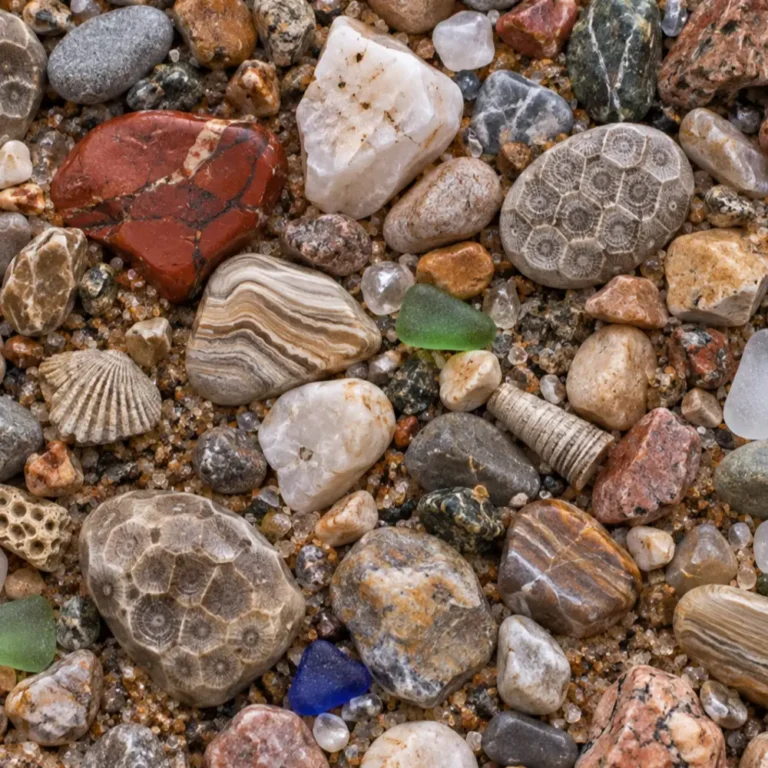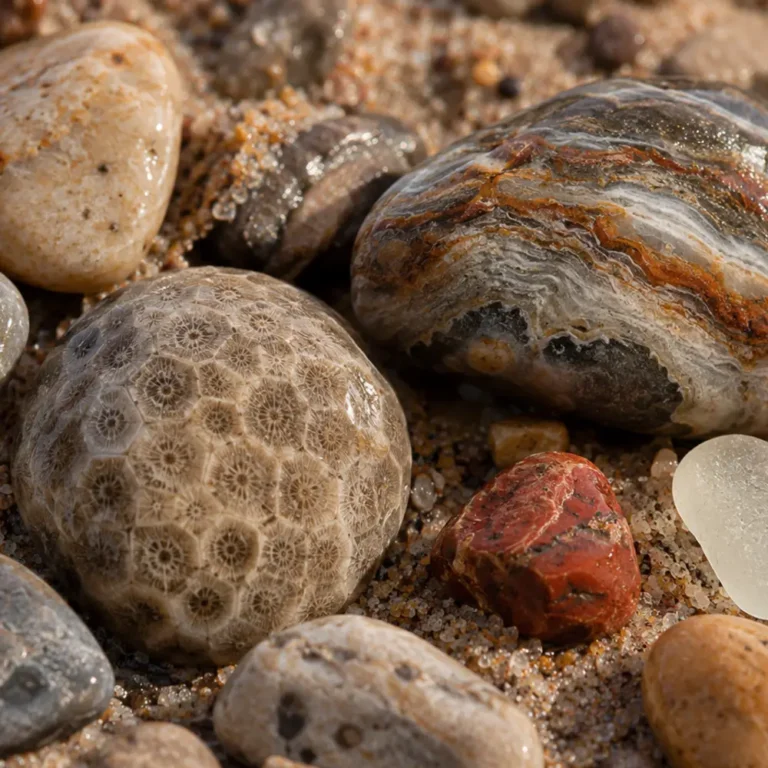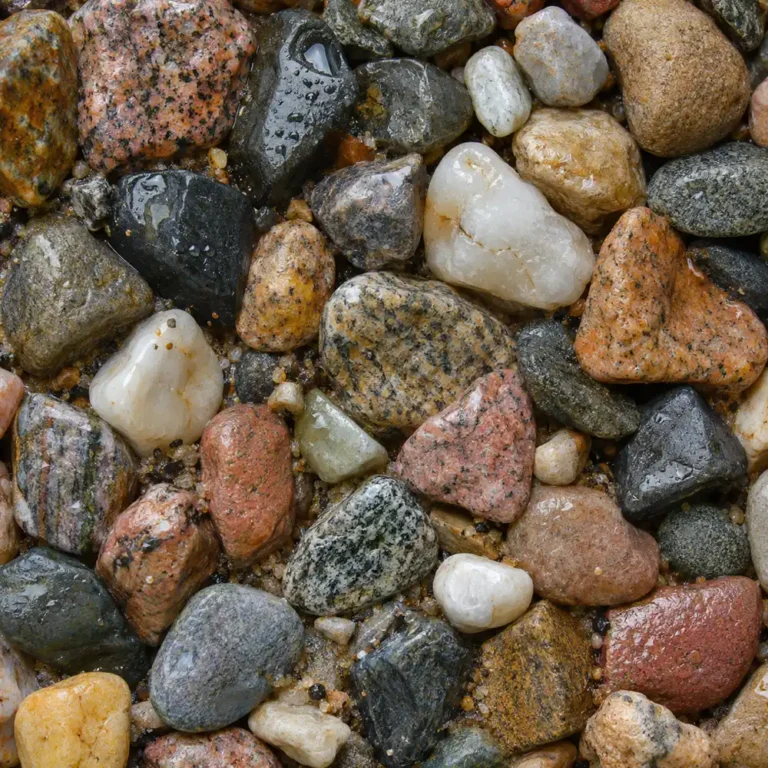
Lake Michigan’s beaches are best known for fossils: Petoskey stones, Charlevoix stones and other fossil corals, crinoid “Cheerios” and fossil sponges, mixed with granite, jasper and other stones the glaciers brought from the north. The richest rock hunting is on the Michigan side, especially the northwest Lower Peninsula. You can collect on many public beaches, but not in Indiana Dunes or Sleeping Bear Dunes, where taking rocks is illegal under federal law.
| What you can find | What it is | Where it’s most common |
|---|---|---|
| Petoskey stone | Fossil colony coral with six-sided cells and dark “eyes” | Northwest Lower Peninsula (Petoskey, Charlevoix, Traverse City) |
| Charlevoix stone | Honeycomb fossil coral (Favosites), cells without eyes | Michigan shore, from the northern tip of the Lower Peninsula south to around Manistee |
| Crinoid stems | Small fossil discs with a hole in the center, like Cheerios | Many Michigan beaches |
| Horn coral | A single cone- or horn-shaped fossil coral | Michigan beaches |
| Stromatoporoids | Fossil sponges that built reefs about 430 million years ago | Michigan beaches |
| Organ pipe coral (Syringopora) | Bundles of thin fossil tubes | Michigan beaches |
| Leland Blue | Blue slag glass from an 1870s iron furnace | Around Leland, on the Leelanau Peninsula |
| Granite | Speckled igneous rock, often with pink or red feldspar | All around the lake |
| Jasper | Orange to tan (or red) opaque chert | All around the lake |
| Beach glass | Old glass smoothed by the waves | All around the lake |
What rocks can you find on Lake Michigan beaches?
Lake Michigan beach rocks come from two places:
1. The bedrock around the lake. Much of the Michigan Basin is made of limestone and other sedimentary rock that formed in warm, shallow seas hundreds of millions of years ago. That’s where the fossils come from. Most fossils on Michigan’s beaches are marine invertebrates, and corals are generally the most common.
2. The glaciers. Ice Age glaciers carried rocks south from northern Michigan, Wisconsin and Canada: granite, basalt, jasper and many others. That’s why you’ll find rocks on Lake Michigan beaches that formed hundreds of miles away.
The fossils
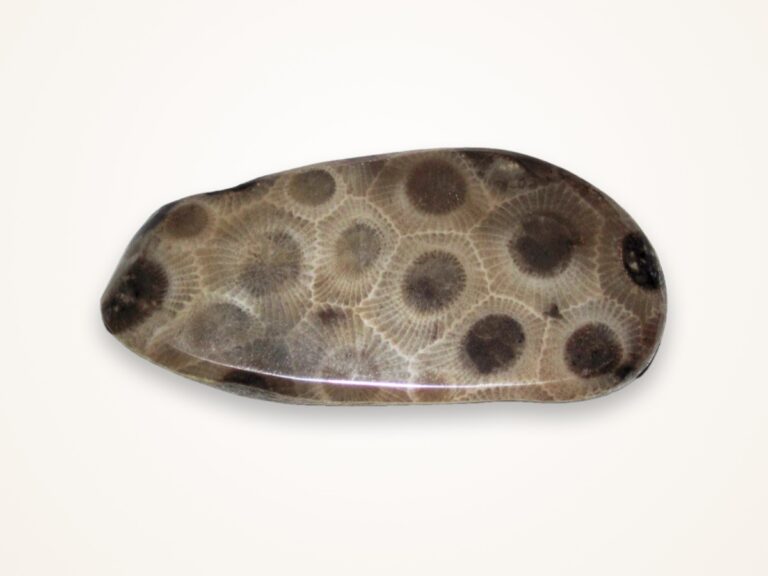
- Petoskey stones: the star of Lake Michigan. Six-sided cells with a dark eye in the center, easiest to see when wet. See our Petoskey stone guide.
- Charlevoix stones (honeycomb or favositid corals): a lacy honeycomb pattern, smaller cells than a Petoskey stone and no eyes.
- Crinoids: relatives of starfish, also called sea lilies. Their stems break into small round segments with a hole in the middle that look like Cheerios. You’ll usually find single segments rather than whole animals.
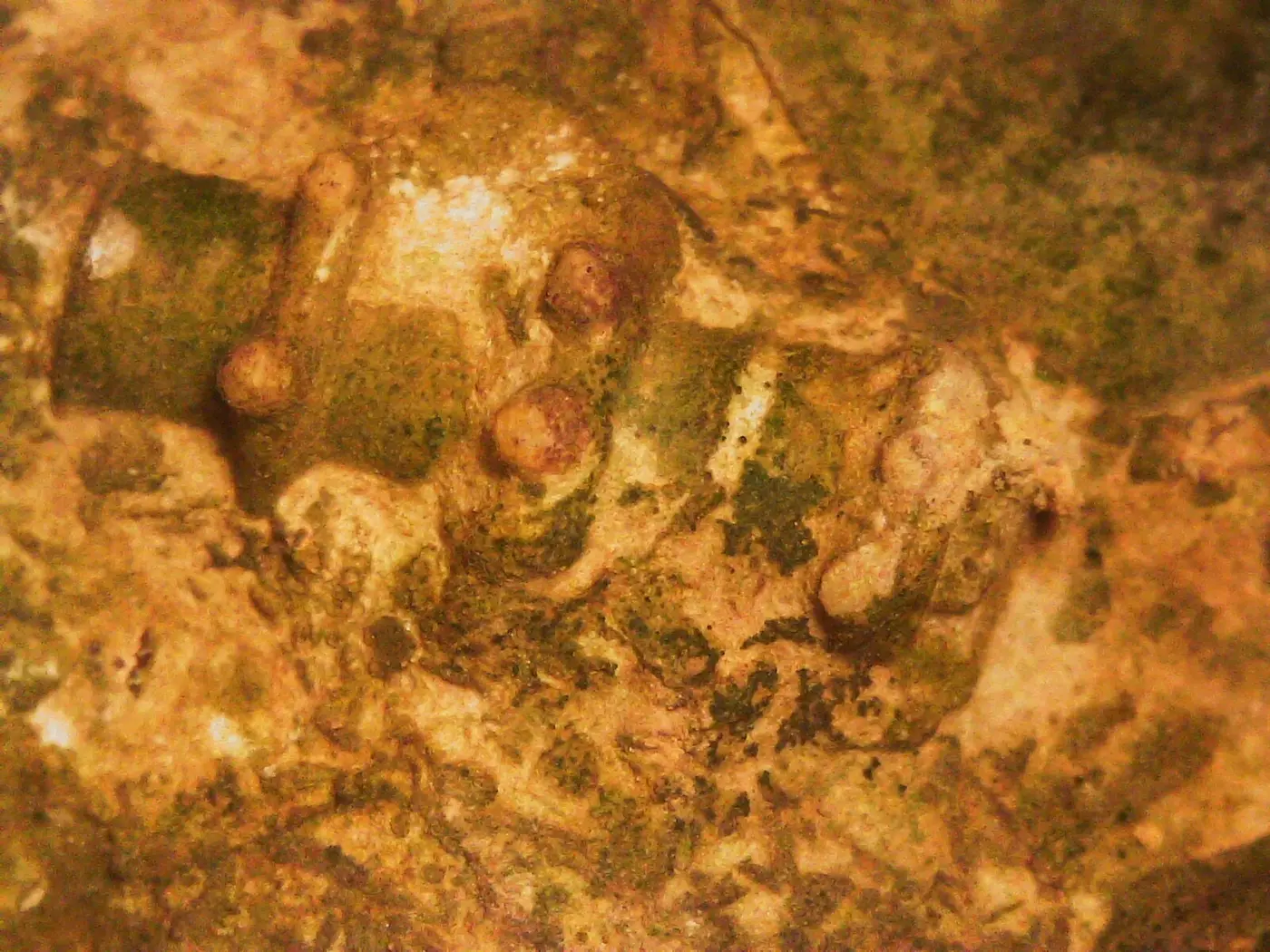
- Horn corals: solitary corals shaped like a cone or horn, with lines radiating from the center like the spokes of a wheel.
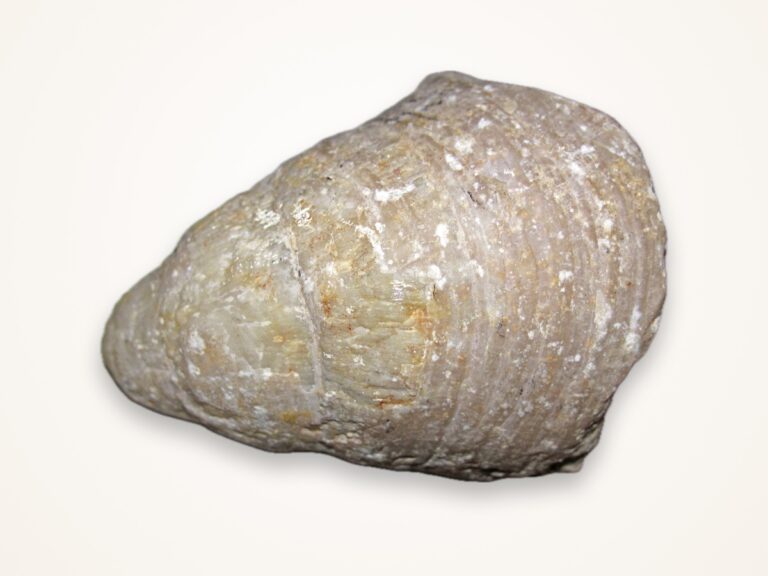
- Stromatoporoids: extinct stony sponges that built reefs in the Silurian period.
- Organ pipe corals: bundles of thin tubes.
- Brachiopods: shells that look a bit like clams, sometimes found between the layers of flaky shale or washed smooth on the beach.
The stones
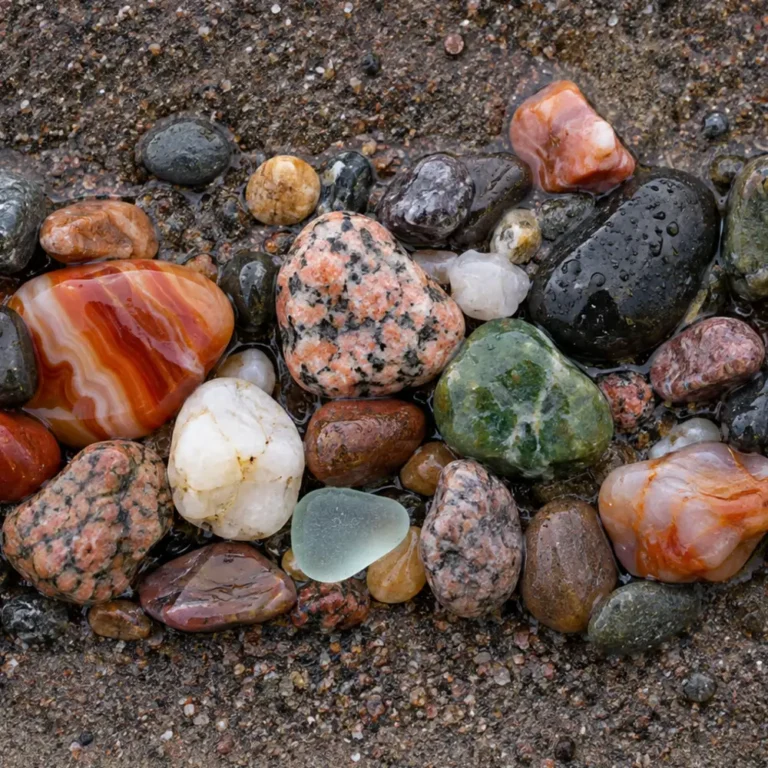
- Granite: speckled, often with pink or red potassium feldspar. Granite is abundant in northern Wisconsin, the Upper Peninsula and Ontario, and glaciers brought it south.
- Jasper: an orange, tan or red, opaque variety of chert.
- Lake Superior agates and other northern stones occasionally turn up on Lake Michigan beaches too, carried by the glaciers, but they’re much rarer than on Lake Superior.
The man-made “rocks”
Not everything on the beach is natural:
- Leland Blue and other slag: glassy waste from old iron furnaces. Leland Blue is blue; other slag can be black and shiny, sometimes almost iridescent, from coal-burning ships or iron smelting.
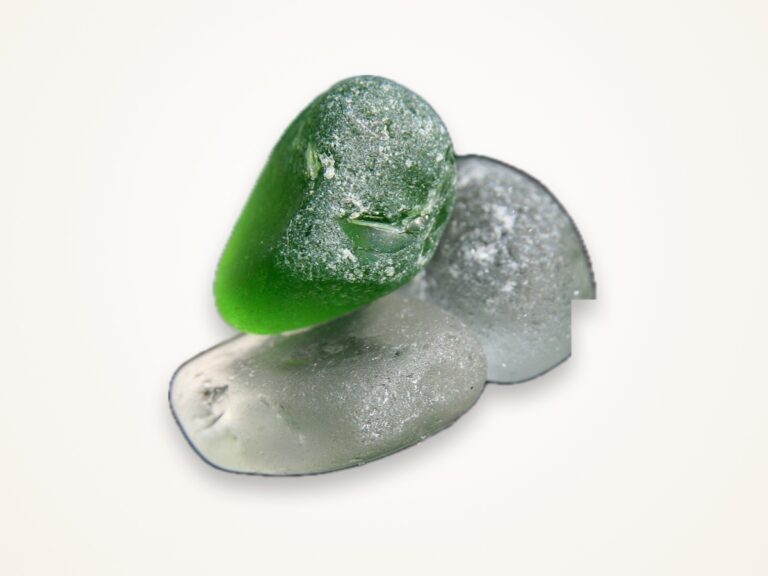
- Beach glass: bottle and window glass smoothed by the waves.
- Concrete: easy to mistake for a natural rock called conglomerate.
Where are the best places to find rocks on Lake Michigan?
| Area | What it’s known for |
|---|---|
| Northwest Lower Peninsula, Michigan (Petoskey, Charlevoix, Leelanau, Traverse City) | The best area for Petoskey and Charlevoix stones; Leland Blue around Leland |
| West Michigan shore (south of Manistee) | Fossil corals, crinoids, granite and jasper on the rockier stretches |
| Upper Peninsula, Lake Michigan shore | Glacial stones and fossils |
| Wisconsin shore (including Door County) | Glacial stones and fossils from the local bedrock |
| Illinois and Indiana (Chicago area, Indiana Dunes) | Mostly sand beaches; fossils, glacial stones, beach glass and slag on some stretches |
Tips for any Lake Michigan beach:
- Skip the pure-sand beaches. Look for stretches with gravel and pebbles.
- Go after a storm or high waves. The bigger the waves, the more new rocks get uncovered.
- Spring is a great time, after winter ice has reworked the beaches.
- Look at wet stones. Patterns and colors show up much better when wet.
- Avoid the busiest beaches in summer. Famous spots like Petoskey State Park get picked over fast. Quieter rocky stretches, early mornings and the off-season pay off.
- Expect a mixed haul. Most of what you’ll bring home is granite, limestone and fossil fragments, with a Petoskey or two if you’re lucky. That’s normal.
Can you take rocks from Lake Michigan?
Yes in many places, but not everywhere. The rules depend on the state and on who manages the beach:
| Where | Can you collect? |
|---|---|
| Michigan state land and Great Lakes shoreline managed by the state | Yes, up to 25 lb per person per year in total, for personal, non-commercial hobby use (Michigan Administrative Code R 299.922) |
| Sleeping Bear Dunes National Lakeshore (Michigan) | No. Removing stones from the lakeshore is illegal under federal law |
| Indiana Dunes National Park (Indiana) | No. Collecting rocks, fossils or sand is prohibited (36 CFR 2.1) |
| Indiana Dunes State Park (Indiana) | Indiana state park rules aim to keep the landscape “in its natural condition” and forbid damaging rocks. Ask the park office before taking anything |
| Illinois state parks (e.g., Illinois Beach State Park) | Illinois rules prohibit removing natural property from state sites. Ask the park before collecting |
| Wisconsin state properties | Depends on the property. Some sites are closed to collecting |
| City and county beaches | Rules vary. Look for posted signs or ask the local parks office |
| Private shoreline | Only with the owner’s permission |
Never collect artifacts (arrowheads, pottery, old tools): leave them in place and report them to the land manager. See our full guide to rock collecting rules.
Frequently asked questions
What is the most famous rock in Lake Michigan?
The Petoskey stone, a fossil coral that is Michigan’s official state stone. It’s found mostly on the Lake Michigan beaches of the northwest Lower Peninsula.
What are the rarest rocks found in Lake Michigan?
Large, well-patterned Petoskey stones, bright Leland Blues, and stones carried from the north by glaciers, like Lake Superior agates, are among the rarer finds on Lake Michigan beaches.
Are there agates on Lake Michigan?
Occasionally. Glaciers carried some Lake Superior agates south, so they can turn up on Lake Michigan beaches, but they’re much rarer than on Lake Superior.
Can you find fossils on Lake Michigan beaches?
Yes. Fossils are the main attraction: Petoskey and Charlevoix stones, crinoid stems, horn corals, fossil sponges and brachiopods. Most come from the limestone bedrock of the Michigan Basin.
Can you take rocks from Indiana Dunes?
Not inside Indiana Dunes National Park: collecting rocks, fossils and sand is prohibited.
What are the round rocks with a hole in the middle?
Those are probably crinoid stem segments, fossils of sea lilies. They look like small Cheerios.
Explore Lake Michigan
- Petoskey stone: what it is, where to find it, and the rules
- How to polish Petoskey stones
- Leland Blue
- Beach glass on the Great Lakes
- Rockhounding in Michigan
- Rock collecting rules
- Other Great Lakes: Lake Superior, Lake Huron, Lake Erie, Lake Ontario
- Rockhounding by state: Michigan, Wisconsin
Sources (10)
- Field Museum (Paul Mayer, Head of Geology Collections), “Beachgoer’s Guide to Lake Michigan Fossils and Rocks” (2017): https://www.fieldmuseum.org/blog/beachgoers-guide-lake-michigan-fossils-and-rocks
- Michigan EGLE, “How to find fossils on Michigan beaches” (May 21, 2026): https://www.michigan.gov/egle/newsroom/mi-environment/2026/05/21/how-to-find-fossils-on-michigan-beaches
- Michigan EGLE, Rockhounding: Fossils: https://www.michigan.gov/egle/public/learn/geology/rockhounding/fossils
- Beachcombing Magazine, “Identifying Fossils on the Great Lakes Shores”: https://www.beachcombingmagazine.com/blogs/news/fossils-on-the-great-lakes-shores
- Visit Charlevoix, Charlevoix Stone: https://visitcharlevoix.com/CharlevoixStone
- National Park Service, Indiana Dunes, “Know Before You Go: Rules for Natural Items”: https://www.nps.gov/indu/learn/management/naturalitems.htm
- National Park Service, Sleeping Bear Dunes, “Beaches”: https://www.nps.gov/slbe/learn/nature/beaches.htm
- Michigan Administrative Code R 299.922(hh): https://www.law.cornell.edu/regulations/michigan/Mich-Admin-Code-R-299-922
- Illinois Administrative Code, Title 17, Section 110.70: https://www.ilga.gov/ftp/JCAR/AdminCode/017/017001100A00700R.html
- Photo credits (via Wikimedia Commons; some backgrounds removed): James St. John (CC BY 2.0); Fossiladder13 (CC BY-SA 4.0); Larsgl (public domain); Wilson44691 (public domain).
Last updated: November 29, 2026. Spotted something out of date? Tell us.