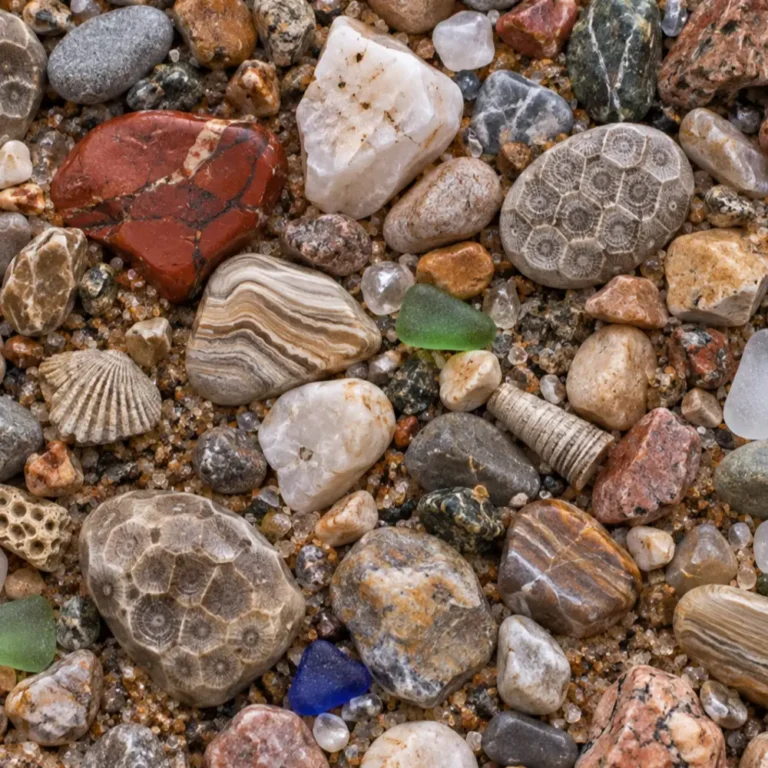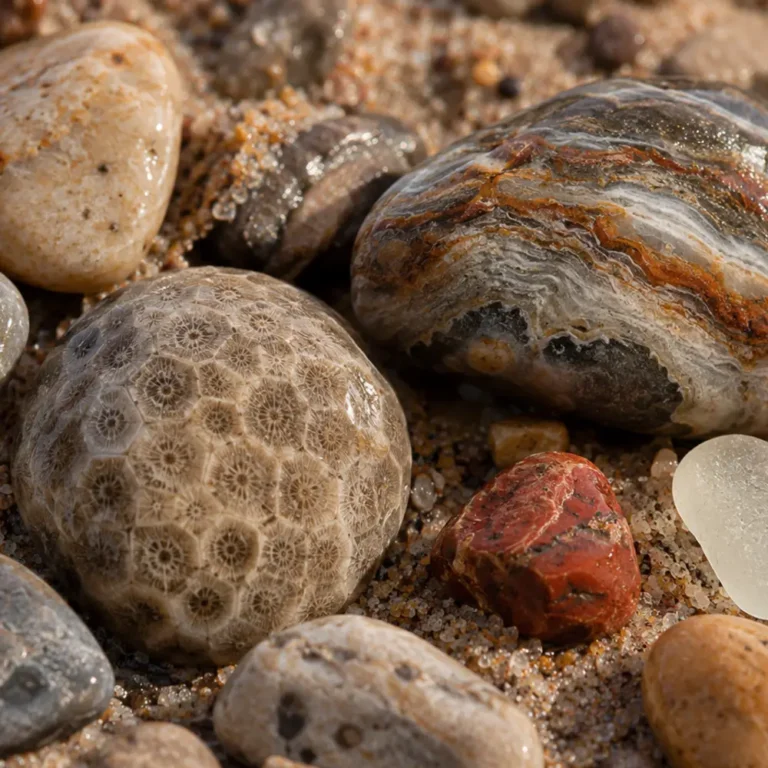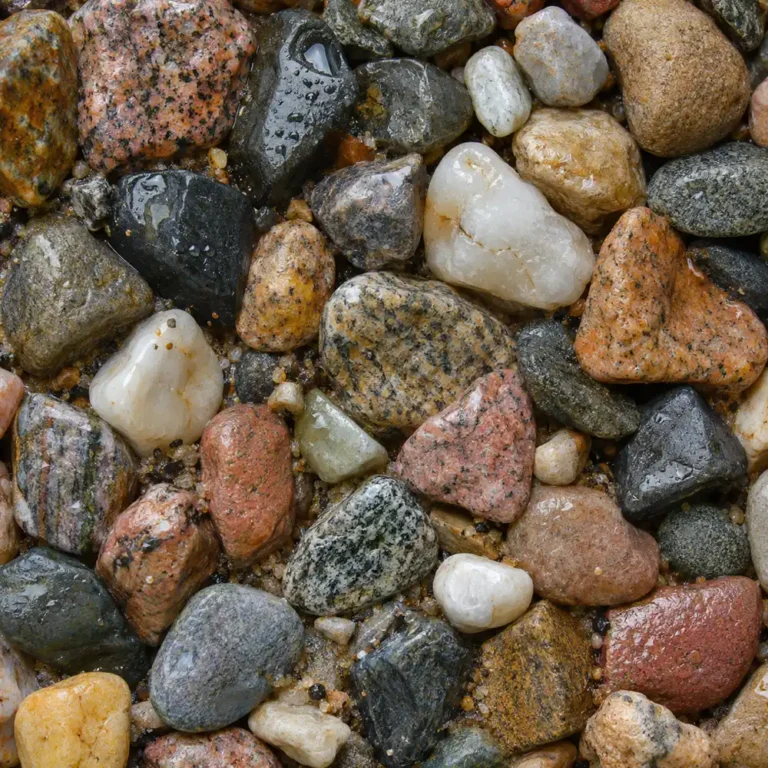
Michigan is one of the best states in the country for rockhounding, or rock hunting as most people call it: it touches four Great Lakes and has Petoskey stones, Lake Superior agates, Yooperlites, greenstones, native copper, puddingstones and fossils. You can collect up to 25 pounds of rocks, minerals and fossils per person per year on state land, including state parks, but collecting is illegal in national parks and lakeshores like Sleeping Bear Dunes, Pictured Rocks and Isle Royale.
| Michigan’s official rock symbols | |
|---|---|
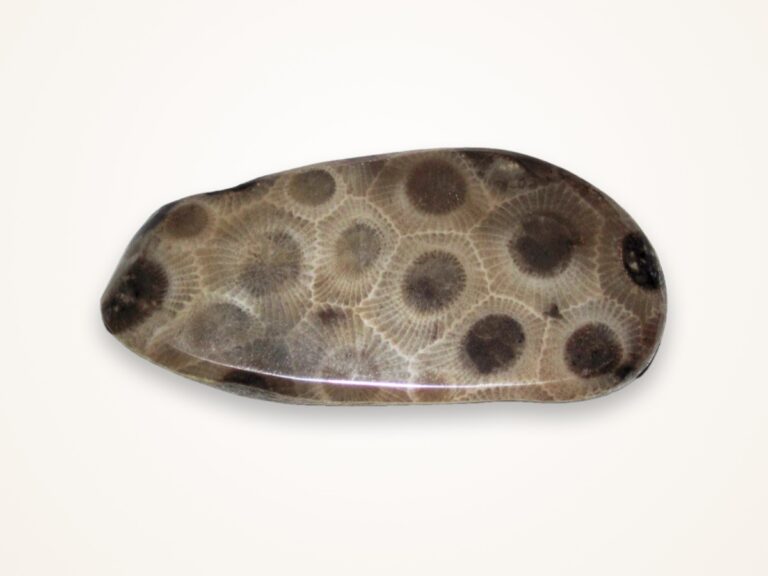
| State stone | Petoskey stone, a fossil coral (1965) |
| State gem | Chlorastrolite, or Isle Royale greenstone (1972) |
| State fossil | Mastodon (2002) |
What rocks can you find in Michigan?
| Rock or stone | What it is | Where in Michigan |
|---|---|---|
| Petoskey stone | Fossil colony coral with six-sided cells and dark eyes | Lake Michigan beaches of the northwest Lower Peninsula; some Lake Huron shores |
| Charlevoix stone | Honeycomb fossil coral without eyes | Lake Michigan shore, from the northern Lower Peninsula south to around Manistee |
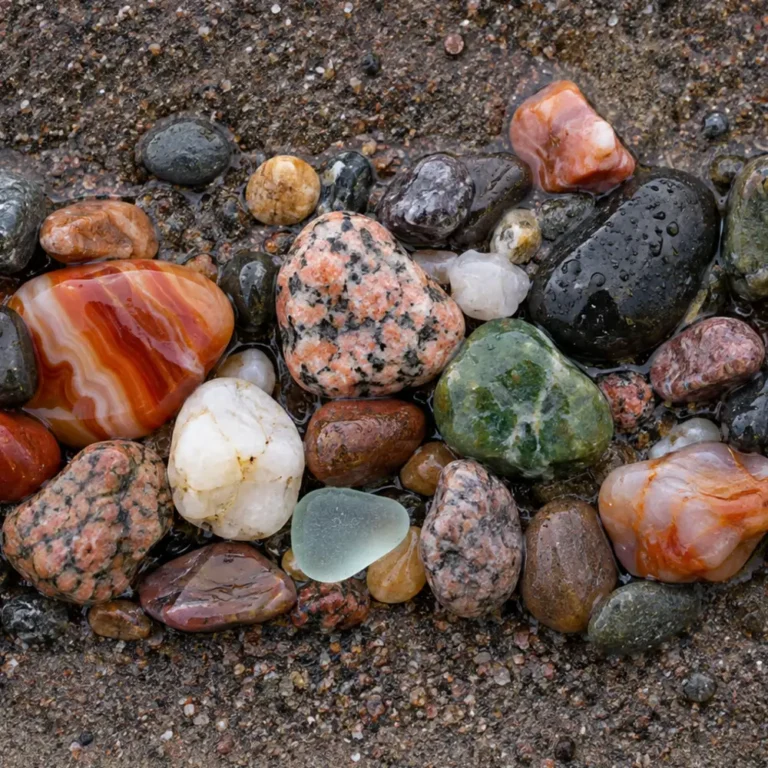
| Lake Superior agate | Banded red, orange and white chalcedony | Lake Superior beaches of the Upper Peninsula; gravel pits statewide |
| Yooperlite (fluorescent syenite) | Gray stone that glows orange under UV light | Lake Superior shore of the Upper Peninsula |
| Greenstone (chlorastrolite) | Green “turtle-back” pattern; the state gem | Keweenaw Peninsula (no collecting on Isle Royale) |
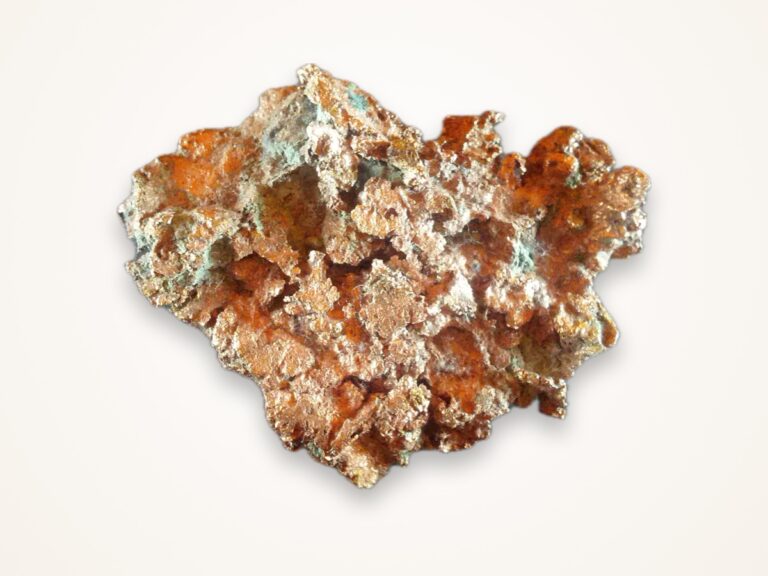
| Native copper | Pure copper, often green on the outside | Keweenaw Peninsula |
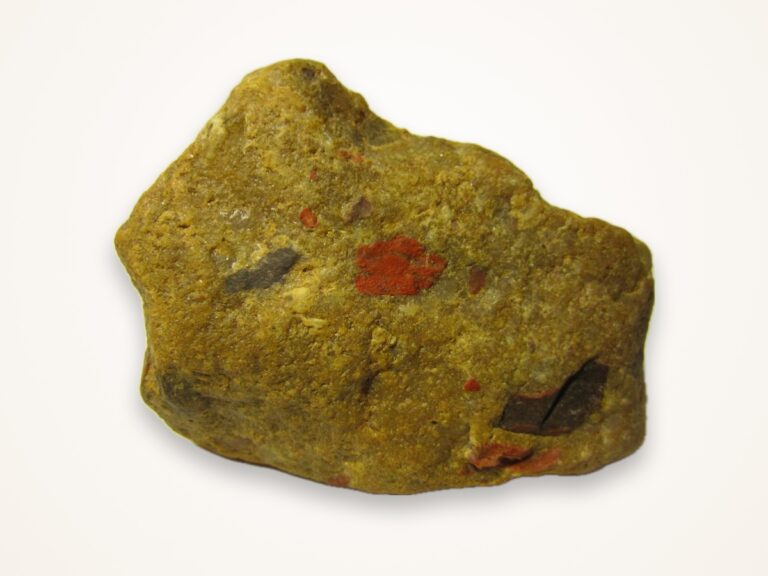
| Puddingstone | White quartzite dotted with red jasper pebbles | Northern Lake Huron, especially around Drummond Island |
| Leland Blue | Blue slag glass from an 1870s iron furnace | Around Leland, Leelanau Peninsula |
| Fossils (crinoids, horn corals, brachiopods) | Marine fossils from ancient seas | Lake Michigan and Lake Huron shores; Rockport quarry near Alpena |
| Beach glass | Glass smoothed by the waves | Beaches statewide |
Where to go rockhounding in Michigan, by region
Northwest Lower Peninsula (Lake Michigan)
The home of the Petoskey stone. The rocky beaches from Traverse City to Petoskey and Charlevoix are the classic hunting grounds, along with the Leelanau Peninsula, where Leland Blue turns up around Leland. Remember that Sleeping Bear Dunes National Lakeshore is off-limits for collecting. More in our Lake Michigan guide.
Upper Peninsula, Lake Superior shore
The best region for Lake Superior agates (“Lakers”) and Yooperlites, from the Keweenaw to Whitefish Point. The Keweenaw Peninsula adds native copper, greenstones and the rare copper replacement agates found nowhere else in the world. Pictured Rocks National Lakeshore and Isle Royale are off-limits. More in our Lake Superior guide.
Northern Lake Huron and Drummond Island
Puddingstones, white quartzite studded with red and brown jasper, were carried here by glaciers from Ontario. The rocky shores around Drummond Island (reached by ferry from DeTour Village) are the best-known area. Some sites there, like the Fossil Ledges, don’t allow collecting: obey posted signs.
Northeast Lower Peninsula (Lake Huron)
Fossils from the Devonian period. Rockport Recreation Area near Alpena, a former limestone quarry managed by the Michigan DNR, is a popular place to collect fossils within the state’s 25-pound yearly limit. A Recreation Passport is required for vehicle entry.
Southwest Michigan (Lake Michigan)
Fossil corals, crinoids, granite and jasper on the rockier stretches of the Lake Michigan shore, plus beach glass.
Inland Michigan
Glaciers left agates, jasper, granite and many other stones in gravel across the state. Gravel pits, gravel roads and fields can be productive, but only with the owner’s permission.
What are the rules for collecting rocks in Michigan?
On Michigan state land, you can collect up to 25 pounds of rocks, mineral specimens and invertebrate fossils per person per year, for personal, non-commercial hobby use. That’s a yearly total across all your trips, not 25 pounds per beach. The rule comes from Michigan’s state land use rules (Michigan Administrative Code R 299.922) and covers land managed by the Department of Natural Resources, including state parks and state forests.
| Where | Can you collect? |
|---|---|
| State parks, recreation areas and state forests | Yes, up to 25 lb per person per year in total |
| Great Lakes beaches managed by the state | Yes, with the same 25 lb yearly limit |
| National parks and lakeshores (Sleeping Bear Dunes, Pictured Rocks, Isle Royale) | No. Removing rocks is illegal under federal law |
| National forests (Ottawa, Hiawatha, Huron-Manistee) | Generally yes for small amounts, for personal use, with hand tools. The Ottawa National Forest says rockhounding for personal enjoyment needs no special permission or fee. Check with the local ranger district |
| City, county and township parks | Rules vary. Look for posted signs |
| Private land, gravel pits, mine sites | Only with the owner’s permission |
Also good to know:
- Gold-bearing material is excluded from the 25-pound allowance on state land.
- Selling what you collect on state land isn’t allowed: the allowance is for non-commercial hobby use only. Commercial collecting needs a permit.
- Artifacts (arrowheads, pottery, old tools) must be left in place and reported.
- Don’t use power tools or heavy digging equipment in state parks.
- The rule is enforced: in 2015, the state confiscated a 93-pound Petoskey stone pulled from Lake Michigan near Northport.
See our full guide to rock collecting rules.
When is the best time to go rock hunting in Michigan?
- Spring, after the ice goes out: winter ice and waves bring fresh stones onto the beaches.
- Right after storms, never during them. Michigan’s Department of Environment, Great Lakes, and Energy (EGLE) advises going immediately after a storm, when new material is washed up, but not during the storm or in high waves.
- After storms, when big waves turn over the gravel. The bigger the waves, the more new stones you’ll see. Many agate hunters wait for the first calm day after big waves.
- Late fall to spring for fewer crowds: popular beaches get picked over in summer.
- At night, from spring to fall, with a filtered 365 nm UV flashlight for Yooperlites on Lake Superior. Cheap UV lights often show nothing.
Set your expectations: the famous beaches get picked over in summer, and many trips end with a modest haul. Quieter beaches, early mornings and the off-season make the biggest difference.
Michigan rock clubs and resources
Joining a local club is the best way to learn, find good spots and get your finds identified:
- Michigan Geological Survey (Western Michigan University) runs the MGS Rockhounds program, with resources for beginners.
- Michigan Mineralogical Society (michmin.org), one of the state’s long-running mineral clubs.
- Central Michigan Lapidary & Mineral Society (michrocks.org), known for its Petoskey polishing guide.
- Local gem and mineral clubs across the state hold shows, field trips and identification nights.
Frequently asked questions
What is Michigan’s state rock?
The Petoskey stone, a fossil coral, has been Michigan’s state stone since 1965. Michigan’s state gem is chlorastrolite (Isle Royale greenstone), and its state fossil is the mastodon.
How many rocks can you take in Michigan?
Up to 25 pounds per person per year in total from Michigan state land, for personal, non-commercial use.
Can you take rocks from Michigan state parks?
Yes, within the 25-pound yearly limit, by hand, without power tools. National parks and lakeshores are different: collecting is illegal there.
Can you take rocks from Michigan beaches?
On state-managed and many public beaches, yes, within the 25-pound limit and local rules. Not in Sleeping Bear Dunes, Pictured Rocks or Isle Royale. On private beaches, only with permission.
Where can you find glowing rocks in Michigan?
The glowing rocks are Yooperlites, syenite stones containing fluorescent sodalite. They’re found mainly on Lake Superior beaches in the Upper Peninsula and glow orange under a 365 nm UV flashlight at night.
Do you need a permit for rockhounding in Michigan?
Not for hobby collecting within the 25-pound limit on state land, or for small personal collecting in most national forests. You need a permit for commercial collecting, and permission for private land.
Related guides
Sources (12)
- State of Michigan, “State Facts and Symbols”: https://www.michigan.gov/som/about-michigan/state-facts-and-symbols
- Michigan Legislature, Senate Fiscal Agency analysis of S.B. 397 (state fossil, Public Act 162 of 2002): https://hercules-milenia.legislature.mi.gov/documents/2001-2002/billanalysis/Senate/htm/2001-SFA-0397-E.htm
- Michigan Compiled Laws, Act 56 of 1972 (state gem): https://legislature.mi.gov/documents/mcl/pdf/MCL-ACT-56-OF-1972.pdf
- Michigan Administrative Code R 299.922: https://www.law.cornell.edu/regulations/michigan/Mich-Admin-Code-R-299-922
- Michigan EGLE, Rockhounding (“annual limit is 25lbs total per person per year on state-owned land”): https://www.michigan.gov/egle/public/learn/geology/rockhounding
- Michigan DNR, Rockport Recreation Area: https://www.michigan.gov/rockport
- USDA Forest Service, Ottawa National Forest, Other recreation opportunities: https://fs.usda.gov/r09/ottawa/recreation/opportunities/other
- Michigan Geological Survey (WMU), MGS Rockhounds: https://mgs.wmich.edu/education-and-outreach/corekids/mgs-rockhounds/
- National Park Service, Sleeping Bear Dunes, “Beaches”: https://www.nps.gov/slbe/learn/nature/beaches.htm
- Wikipedia, “Jasper conglomerate” (puddingstone origin): https://en.wikipedia.org/wiki/Jasper_conglomerate
- Visit Drummond Island, Puddingstones: https://www.visitdrummondisland.com/puddingstones.html
- Photo credits (via Wikimedia Commons; some backgrounds removed): James St. John (CC BY 2.0); John Mortimore (CC BY-SA 3.0); Kdorse (CC BY-SA 3.0).
Last updated: November 29, 2026. Spotted something out of date? Tell us.