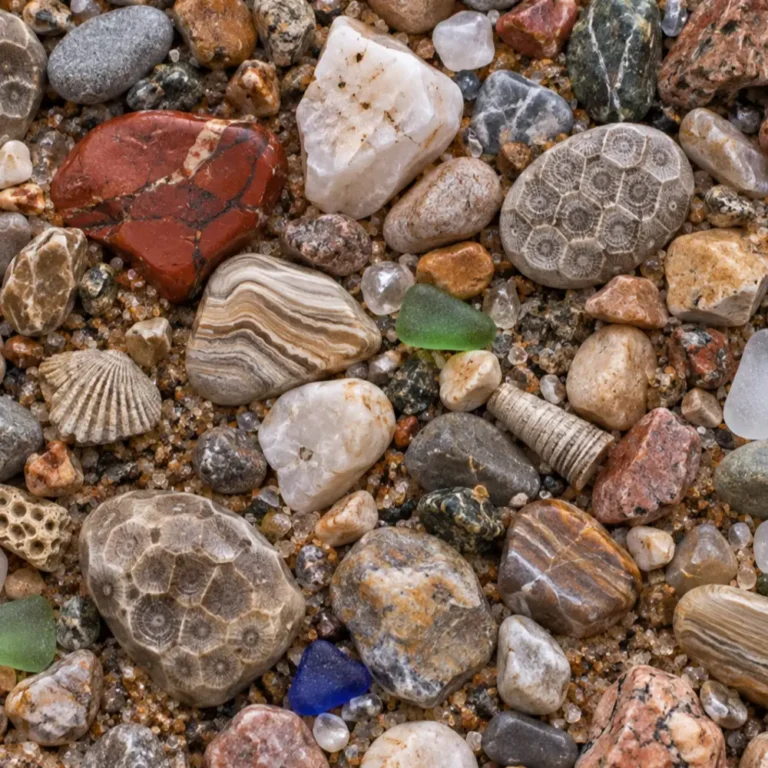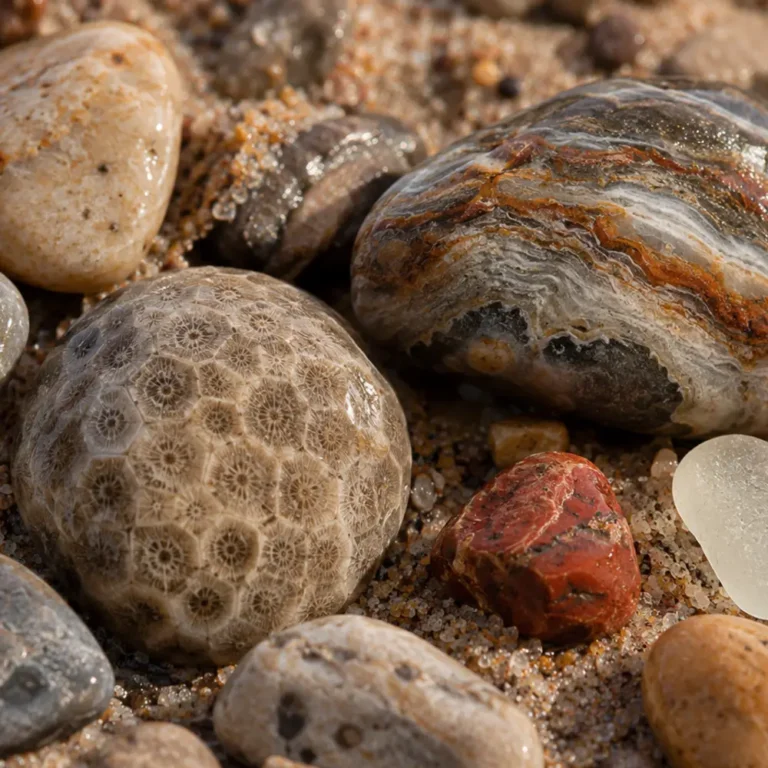
Minnesota is Lake Superior agate country: its state gemstone turns up on public North Shore beaches, in gravel pits and along rivers across much of the state. The catch is that rock collecting is banned in every Minnesota state park and state recreation area, including famous North Shore parks like Gooseberry Falls and Split Rock. Hunt on public beaches and waysides where collecting isn’t prohibited, in national forests for small personal amounts, and in gravel pits with the owner’s permission.
| Minnesota’s official symbols | |
|---|---|
| State gemstone | Lake Superior agate (1969) |
| State fossil | Giant beaver (2025) |
| State rock / mineral | None |
What can you find in Minnesota?
| Find | What it is | Where |
|---|---|---|
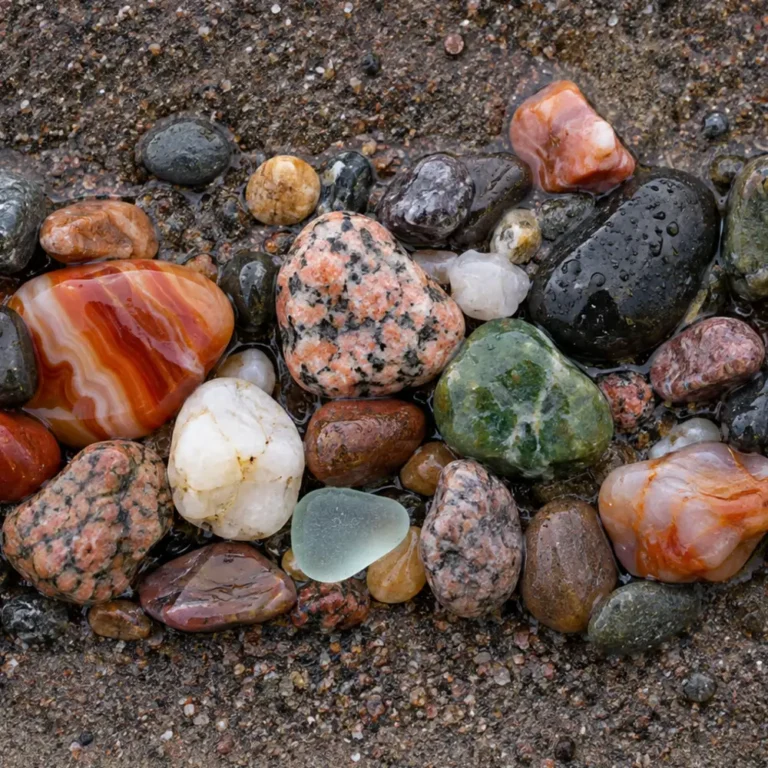
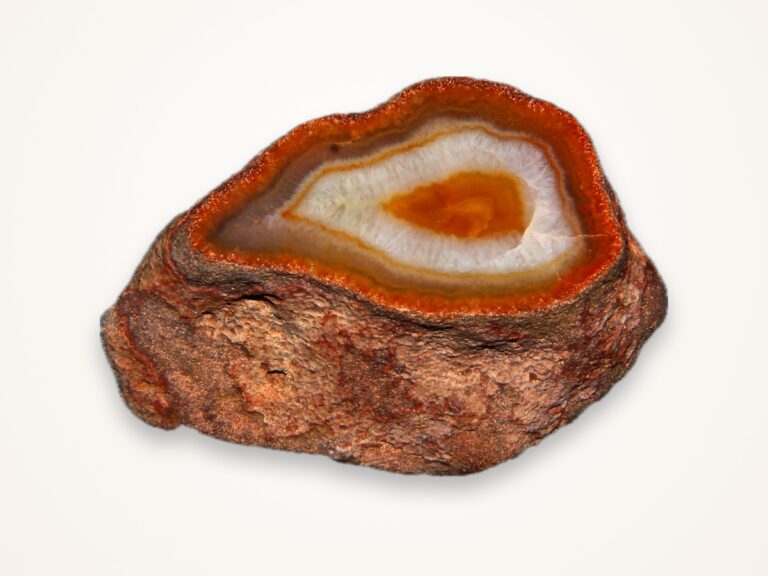
| Lake Superior agate | Banded red, orange and white chalcedony, 1.1 billion years old | North Shore beaches, gravel pits, riverbanks and glacial gravel across much of the state |
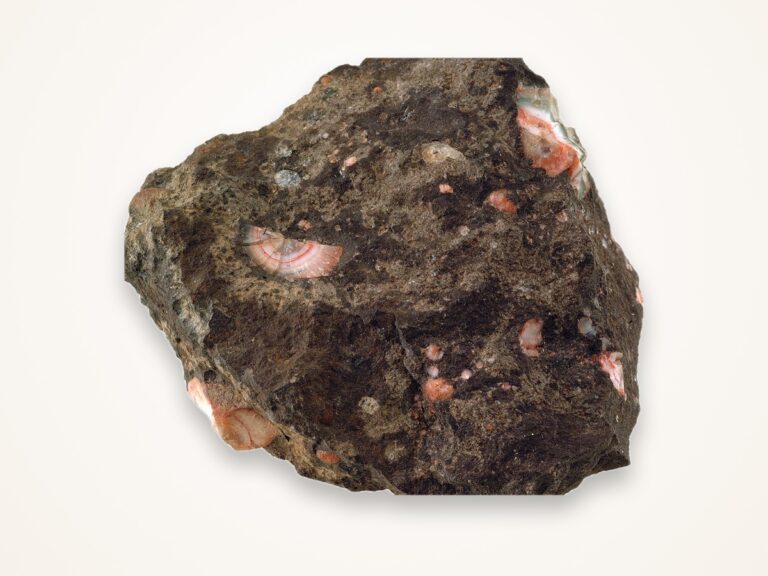
| Thomsonite | Small nodules with pink, green and white “eyes” | North Shore, around Good Harbor Bay southwest of Grand Marais |
| Binghamite (silkstone) | Chatoyant quartz with goethite, used in jewelry | The Cuyuna Iron Range, near Crosby |
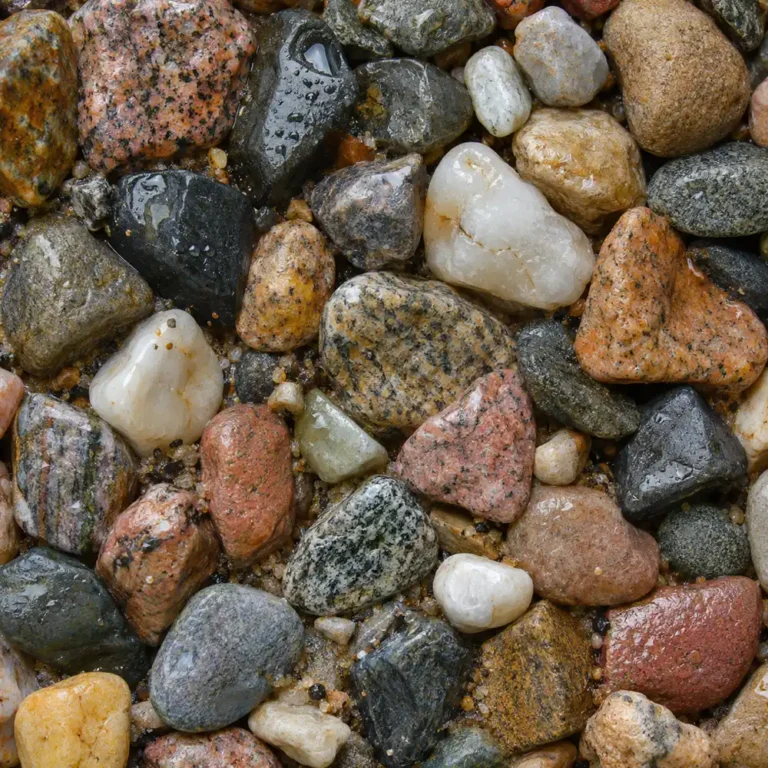
| Basalt, rhyolite, jasper | The everyday rocks of the North Shore | Every North Shore beach |
Where to find agates in Minnesota
The Minnesota DNR says agates turn up “throughout much of Minnesota,” because glaciers spread them far from Lake Superior.
The North Shore of Lake Superior. Public gravel beaches and waysides between Duluth and the Canadian border. Remember that state parks are off-limits for collecting, so focus on public beaches outside them.
Gravel pits. Often the most productive places, because they expose fresh glacial gravel. Most are private: get the owner’s permission first.
Rivers and streams. Gravel bars and riverbanks after high water.
Moose Lake, the “Agate Capital of the World.” The town celebrates Agate Days every July, with a gem and mineral show and the famous Agate Stampede, where agates and coins are dumped on Elm Avenue for the crowd to hunt. Moose Lake State Park has an Agate and Geological Interpretive Center. (No collecting inside the state park.)
When to go
- Spring, when the ice is gone and the beaches have been reworked.
- The first calm day after big waves on the North Shore.
- After heavy rains in gravel pits and on riverbanks, when fresh stones are washed clean.
What are the rules for rock collecting in Minnesota?
| Where | Can you collect? |
|---|---|
| State parks and state recreation areas | No. The DNR states that rock collecting is not allowed in any state park or state recreation area, and state rules prohibit removing geological formations |
| Scientific and Natural Areas (SNAs) | No. Collecting geological formations is prohibited |
| Superior and Chippewa National Forests | Generally yes, small amounts for personal use: federal rules allow “occasionally removing small mineral samples or specimens.” Don’t break apart rocks, and wilderness areas like the Boundary Waters are stricter |
| State forests, wildlife management areas, county land | No clear published rule. Ask the local DNR or county office |
| Lake Superior shoreline | The state doesn’t own a public strip around lakes. Use public beaches, waysides and parks where collecting is allowed; crossing private land requires permission |
| Gravel pits and private land | Only with the owner’s permission |
See our full guide to rock collecting rules.
Frequently asked questions
Where can I find agates in Minnesota?
On public North Shore beaches outside state parks, in gravel pits with permission, and on riverbanks across much of the state, because glaciers spread them widely.
Can you collect agates in Minnesota state parks?
No. Rock collecting isn’t allowed in any Minnesota state park or state recreation area.
What is Minnesota’s state gemstone?
The Lake Superior agate, designated in 1969.
When are Agate Days in Moose Lake?
Every July. Check the Moose Lake Chamber of Commerce for this year’s dates.
Can you collect rocks in the Superior National Forest?
Generally yes, small amounts for personal, non-commercial use, without breaking apart rocks. Wilderness areas are stricter: check with the ranger district.
Related guides
Sources (14)
- Minnesota Legislative Reference Library, State Symbols: https://www.lrl.mn.gov/leg/symbols
- Minnesota Statutes 1.147 (state gemstone): https://www.revisor.mn.gov/statutes/cite/1.147
- Minnesota DNR, “Geology in state parks”: https://www.dnr.state.mn.us/education/geology/digging/stateparks.html
- Minnesota DNR, Recreational Geology: https://dnr.state.mn.us/geologyrec/index.html
- Minnesota DNR, “Minnesota’s State Gem”: https://dnr.state.mn.us/education/geology/digging/agate.html
- Minnesota Rules 6100.0900 (state parks): https://www.revisor.mn.gov/rules/6100/version/2017/full
- Minnesota Rules 6136.0400 (Scientific and Natural Areas): https://www.law.cornell.edu/regulations/minnesota/Minn-R-6136-0400
- 36 CFR 228.4 and 291.11 (Forest Service): https://www.law.cornell.edu/cfr/text/36/228.4 and https://www.law.cornell.edu/cfr/text/36/291.11
- USDA Forest Service, Superior National Forest: https://fs.usda.gov/r09/superior/recreation/opportunities/other
- Minnesota DNR, water law basics (shoreline access): https://www.dnr.state.mn.us/waters/watermgmt_section/pwpermits/waterlaws.html
- MPR News, “With Agate Days, Moose Lake polishes image of the state gem” (2019): https://www.mprnews.org/story/2019/07/15/with-agate-days-moose-lake-polishes-image-of-the-state-gem
- Mindat, Grand Marais / Good Harbor Bay (thomsonite): https://www.mindat.org/loc-250428.html
- Wikipedia, “Binghamite”: https://en.wikipedia.org/wiki/Binghamite
- Photo credits (via Wikimedia Commons; some backgrounds removed): Lech Darski (CC BY-SA 4.0); Shannon Heinle (CC0).
Last updated: November 29, 2026. Spotted something out of date? Tell us.