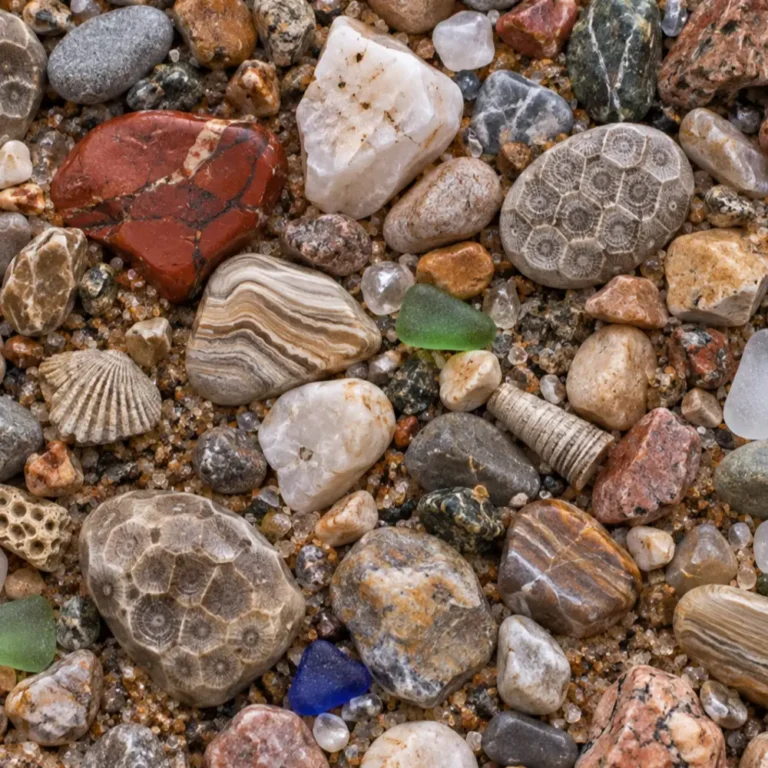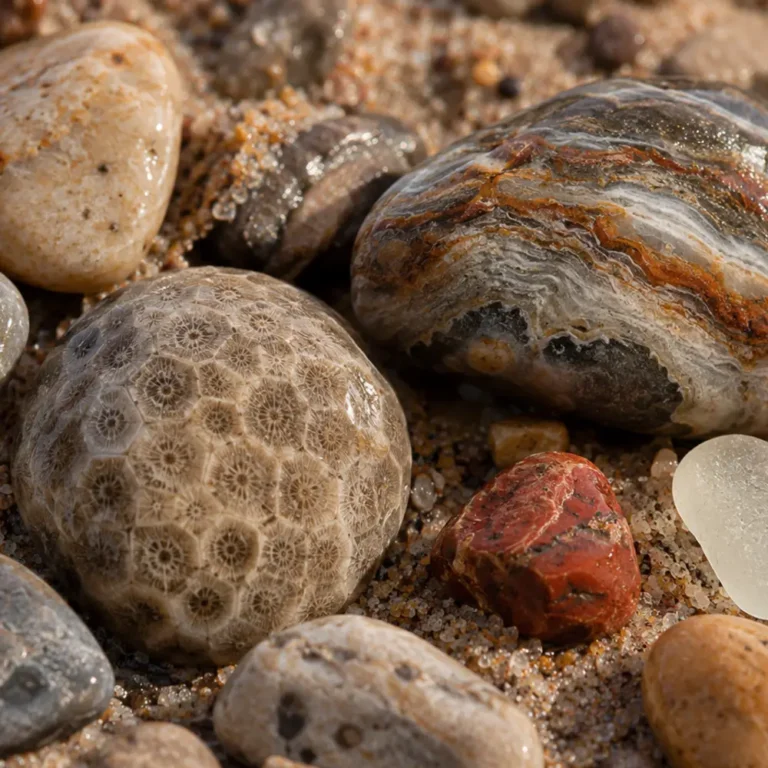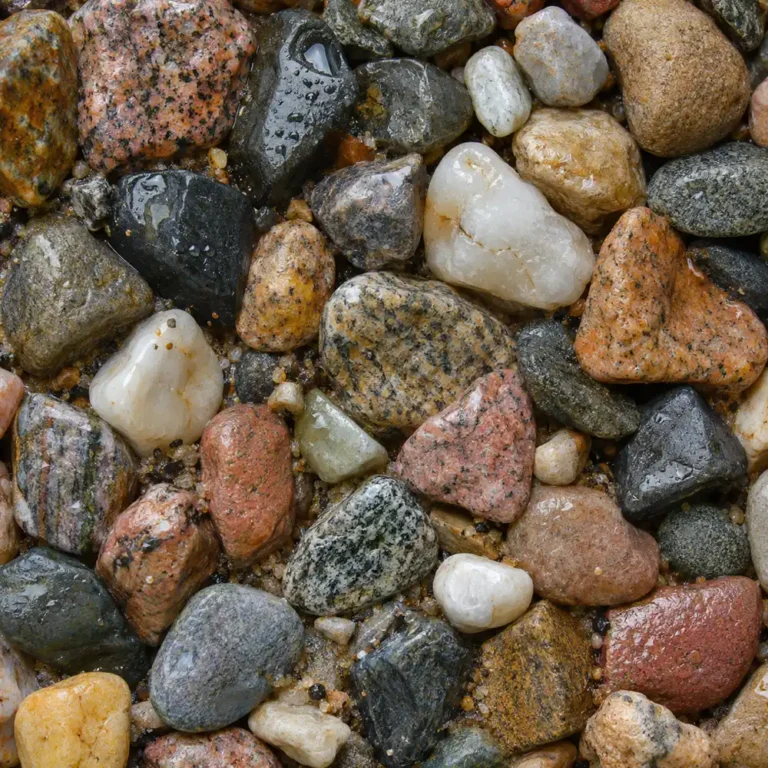
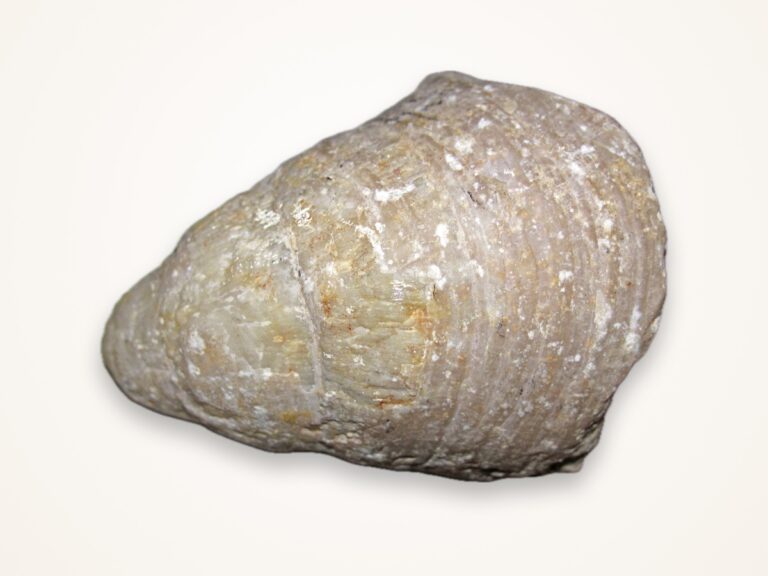
Ohio is one of the best fossil states in the country: Ordovician brachiopods, bryozoans and trilobites weather out of almost every road cut and stream bed in the southwest, and Devonian fossils turn up in the north. It’s also home to Ohio flint, the state gemstone, and Lake Erie’s beach glass. Ohio’s state parks generally prohibit removing rocks, but five state parks have designated areas where fossil collecting is allowed, and there are dedicated fossil parks open to the public.
| Ohio’s official symbols | |
|---|---|
| State gemstone | Ohio flint (1965) |
| State invertebrate fossil | Trilobite Isotelus (1985) |
| State fossil fish | Dunkleosteus terrelli (2021) |
| State mineral | None |
What can you find in Ohio?
| Find | Age | Where |
|---|---|---|
| Brachiopods, bryozoans, gastropods, trilobites | Ordovician (about 445–450 million years) | Southwest Ohio, around Cincinnati: road cuts and stream beds |
| Devonian fossils (trilobites, corals, brachiopods) | Devonian (about 360–390 million years) | Northwest Ohio (Silica Formation near Sylvania), Columbus Limestone, Ohio Shale near Cleveland (fossil fish) |
| Ohio flint | Pennsylvanian | Central Ohio |
| Beach glass | Recent | Lake Erie beaches |
Ohio has no rocks from the age of dinosaurs, so you won’t find dinosaur fossils there.
Where can you legally collect fossils in Ohio?
State parks with fossil collecting areas
The Ohio Department of Natural Resources lists five state parks where fossil collecting is allowed in designated areas: Caesar Creek, Cowan Lake, East Fork, Hueston Woods and Stonelick State Parks. Check at the ranger station for the designated areas and conditions.
At Caesar Creek, collecting takes place in the emergency spillway and requires a free permit from the U.S. Army Corps of Engineers Visitor Center.
Fossil parks
- Oakes Quarry Park (Fairborn)
- Fossil Park (Sylvania), for Devonian fossils
- Trammel Fossil Park (Sharonville), for Ordovician fossils
Lake Erie
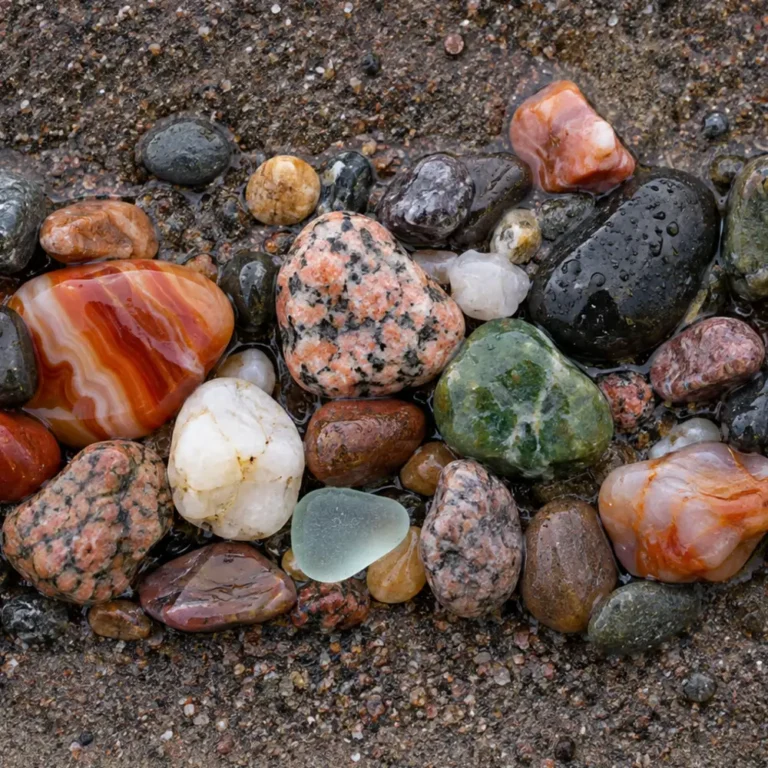
Lake Erie’s Ohio beaches are known for beach glass, especially around Conneaut and Cleveland. See our Lake Erie guide for the rules: state parks don’t allow removing stones without posted permission.
Where collecting is not allowed
- Most Ohio state parks: Ohio’s rule makes it unlawful to remove “minerals, stone, rocks,” except where the state has posted permission to collect fossils or in a designated nature study area.
- Hocking Hills, Clifton Gorge, John Bryan State Park and Nelson-Kennedy Ledges.
- The Glacial Grooves on Kelleys Island, and the public lands of the Lake Erie islands, where fossil collecting is not permitted.
- State nature preserves.
- State forests, without the written permission of the Division of Forestry.
- Road cuts: the Highway Patrol and sheriffs don’t allow vehicles to stop along roads except in emergencies. Don’t collect along busy highways.
When to go
- After heavy rain in creeks and spillways, when fresh fossils are washed out.
- Spring and fall, when vegetation is low and temperatures are comfortable.
- After storms on Lake Erie for beach glass.
Rules at a glance
| Where | Can you collect? |
|---|---|
| Caesar Creek, Cowan Lake, East Fork, Hueston Woods, Stonelick State Parks | Yes, fossils, in designated areas (free permit at Caesar Creek) |
| Other state parks | No, unless permission to collect is posted |
| State forests | No, without written permission |
| State nature preserves, Lake Erie islands public lands, Glacial Grooves | No |
| Fossil parks (Oakes Quarry, Sylvania Fossil Park, Trammel) | Yes, under each park’s rules |
| Wayne National Forest | Generally small amounts for personal use under federal rules. Check with the ranger district |
| Private land | Only with the owner’s permission |
See our full guide to rock collecting rules.
Frequently asked questions
Where can you find fossils in Ohio?
In southwest Ohio’s Ordovician rocks around Cincinnati, and in northwest Ohio’s Devonian rocks. Legal places include five state parks with fossil collecting areas (Caesar Creek, Cowan Lake, East Fork, Hueston Woods, Stonelick) and fossil parks like Oakes Quarry, Sylvania Fossil Park and Trammel Fossil Park.
Can you collect fossils in Ohio state parks?
Only in designated areas of Caesar Creek, Cowan Lake, East Fork, Hueston Woods and Stonelick State Parks. Elsewhere, removing rocks from state parks is prohibited unless permission is posted.
What is Ohio’s state gemstone?
Ohio flint, designated in 1965.
Can you find dinosaur fossils in Ohio?
No. Ohio has no rocks from the age of dinosaurs.
Related guides
Sources (9)
- Ohio DNR, Division of Geological Survey, GeoFacts 17, “Fossil collecting in Ohio” (2014): https://dam.assets.ohio.gov/image/upload/ohiodnr.gov/documents/geology/GF17_Shrake_2014.pdf
- Ohio DNR, GeoFacts 6, state fossils (2023): https://dam.assets.ohio.gov/image/upload/ohiodnr.gov/documents/geology/GF6_Shrake_2023.pdf
- Ohio DNR, GeoFacts 28 (2021): https://dam.assets.ohio.gov/image/upload/ohiodnr.gov/documents/geology/GF28_Wolfe_2021.pdf
- Ohio DNR, Open-File Report 2007-1 (revised 2018), fossil collecting sites: https://dam.assets.ohio.gov/image/upload/ohiodnr.gov/documents/geology/OFR2007_1_Shrake_2018.pdf
- Ohio Revised Code 5.07 (state gemstone): https://codes.ohio.gov/ohio-revised-code/section-5.07
- Ohio Administrative Code 1501:46-3-11 (state parks): https://www.law.cornell.edu/regulations/ohio/Ohio-Admin-Code-1501-46-3-11
- Ohio Administrative Code 1501:3-2-05 (state forests): https://www.law.cornell.edu/regulations/ohio/Ohio-Admin-Code-1501-3-2-05
- 36 CFR 228.4 and 291.11 (Forest Service): https://www.law.cornell.edu/cfr/text/36/228.4
- Photo credits (via Wikimedia Commons; some backgrounds removed): James St. John (CC BY 2.0).
Last updated: November 29, 2026. Spotted something out of date? Tell us.