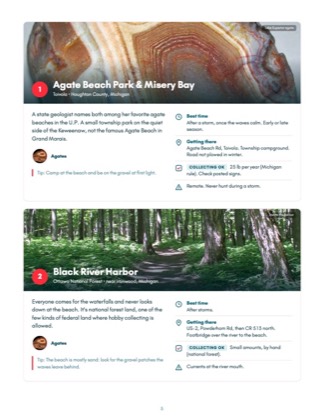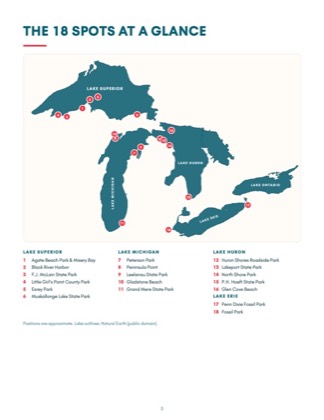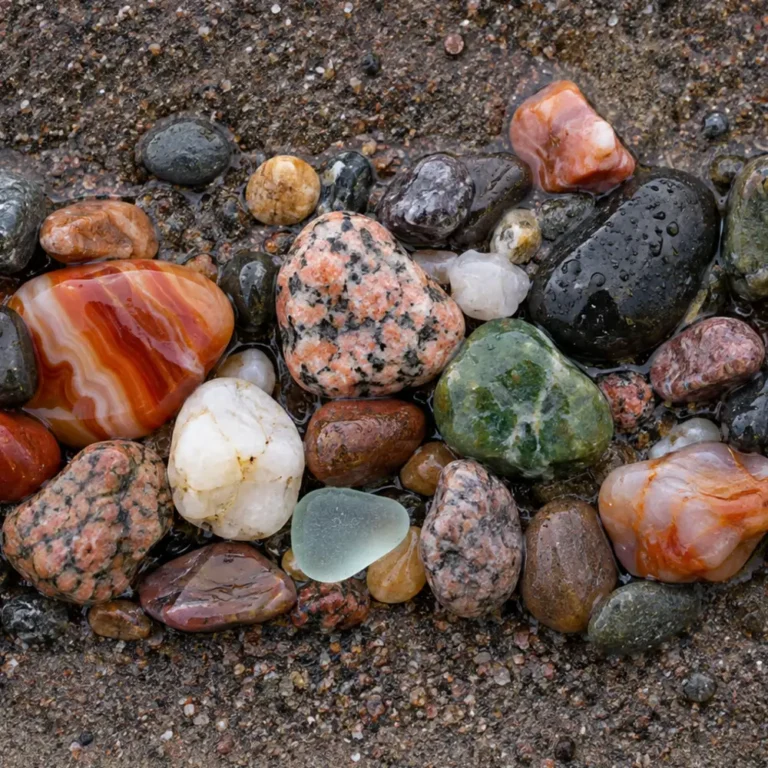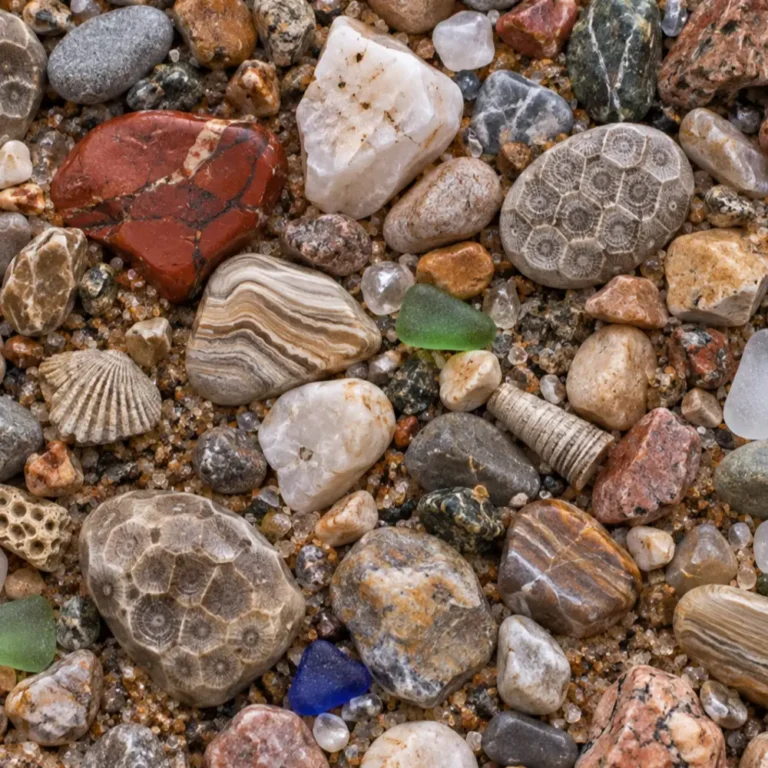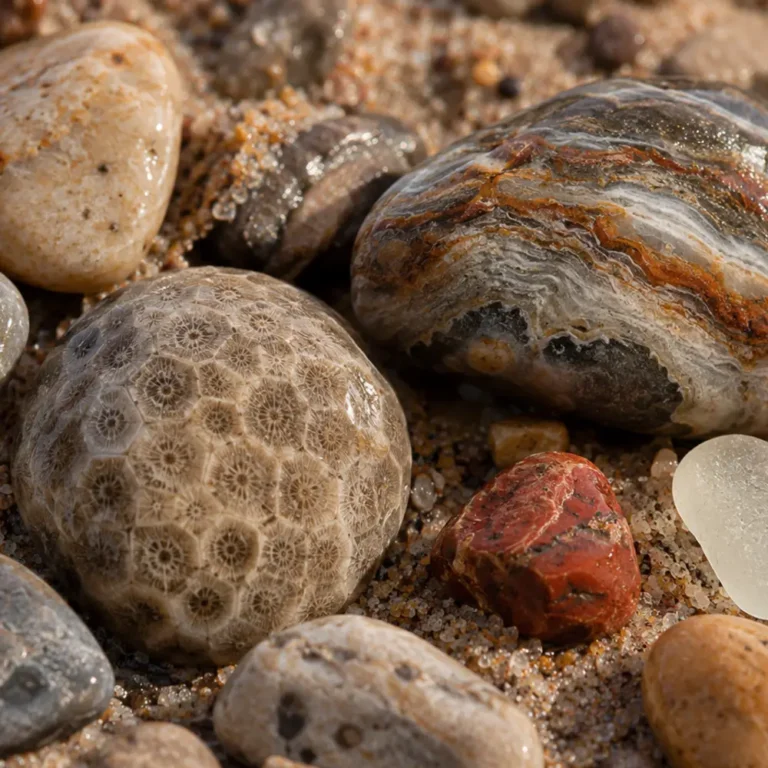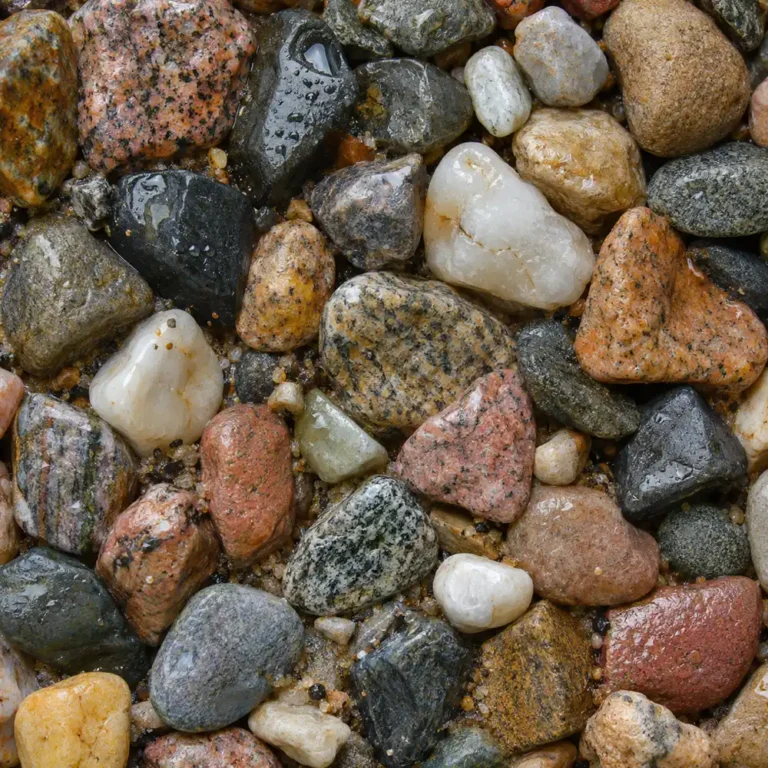
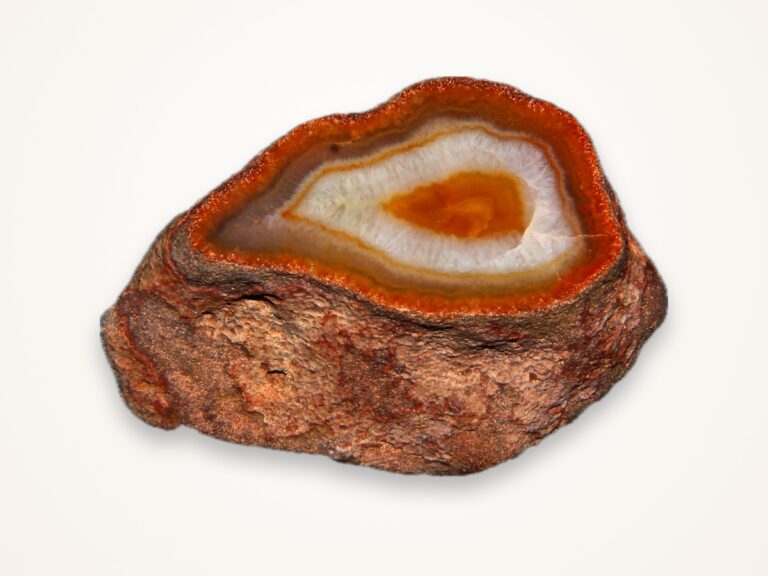
A Lake Superior agate is a banded stone of chalcedony, usually red, orange and white, that formed inside gas bubbles in lava flows about 1.1 billion years ago. They’re among the oldest agates in the world, and Minnesota‘s official state gemstone. Collectors often call them LSAs or simply “Lakers.” You can find them on the gravel beaches of Lake Superior in Minnesota, Wisconsin and Michigan’s Upper Peninsula, and in glacial gravel far inland. Look for translucent, waxy-looking stones with bands and iron-red color.
| Quick facts | |
|---|---|
| What it is | Banded chalcedony (a form of quartz) with iron oxide coloring |
| Age | About 1.1 billion years |
| How it formed | In gas bubbles (vesicles) inside basalt lava flows of the Midcontinent Rift |
| Official status | Minnesota state gemstone since 1969 |
| Hardness | 6.5 to 7 on the Mohs scale |
| Common colors | Red, orange, yellow, white, gray, tan, brown |
| Typical size | About 95% are marble-sized or smaller |
| Where | Lake Superior shores (MN, WI, MI), gravel pits, gravel roads and glacial till across the Upper Midwest |
| Can’t collect in | Minnesota state parks, national parks and lakeshores (Isle Royale, Pictured Rocks, Apostle Islands) |
How did Lake Superior agates form?
About 1.1 billion years ago, North America started to split apart along a 1,200-mile crack called the Midcontinent Rift, running from the Lake Superior area southwest toward Kansas and southeast into Lower Michigan. Huge volumes of iron-rich lava poured out and cooled into basalt.
As the lava hardened, bubbles of water vapor and carbon dioxide were trapped inside, leaving small cavities called vesicles. Over time, groundwater rich in silica and iron seeped into these cavities. Layer by layer, it deposited chalcedony (microscopic quartz fibers) and iron oxides, creating the bands. The iron is what gives the agates their red, orange and yellow colors.
The agates stayed locked in the basalt until the Ice Age. Glaciers moving south from Canada crushed the basalt and freed the agates, which are much harder than the rock around them. The ice then carried them across the Midwest. That’s why Lake Superior agates turn up not just on the lake’s shores, but in gravel as far away as Iowa, Nebraska, Kansas and Missouri.
How do you identify a Lake Superior agate?
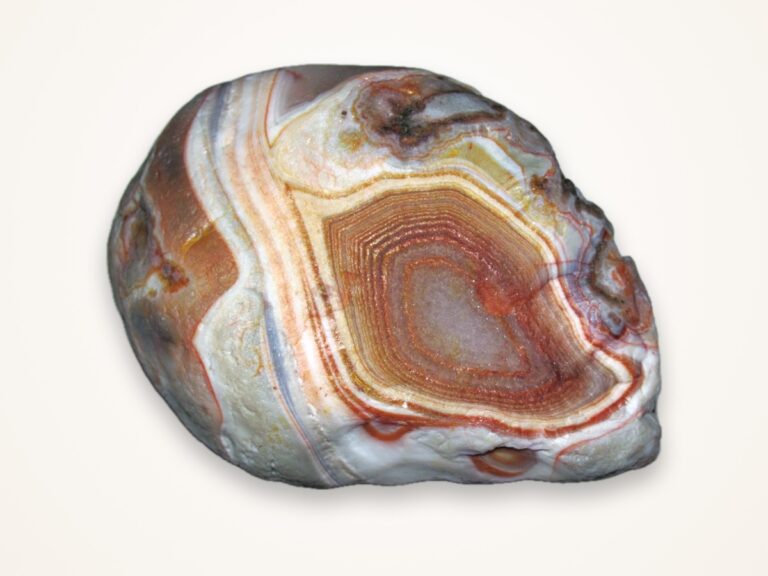
Look for these clues:
- Bands. Thin, curved or straight layers, often following the shape of the stone. Even a small patch of bands is a good sign.
- Translucency. Hold the stone up to the sun or shine a flashlight through it. Agate lets light through, especially at thin edges. Most other beach rocks don’t.
- Waxy luster. Agate looks slightly waxy or glossy, even when dry.
- Iron colors. Red, orange or yellow staining from iron oxides. Under that stain, the stone itself is often gray.
- Shell-like fractures. Broken edges show smooth, curved (conchoidal) breaks, like broken glass.
- Small size. Most agates are marble-sized or smaller. Train your eye on small stones.
Wet stones show more. Water brings out the color, the bands and the translucency. Search along the waterline, or carry a spray bottle.
Is this an agate? The quick check
If you can only remember one test: hold it up to the light. A Lake Superior agate lets light through at its edges and usually shows at least a few bands. If no light passes through and there are no bands, it’s probably jasper, chert or another rock. If it’s glittery inside with no fine bands, it’s likely quartz. Still unsure? A local rock club can identify it in seconds.
Lake Superior agate lookalikes
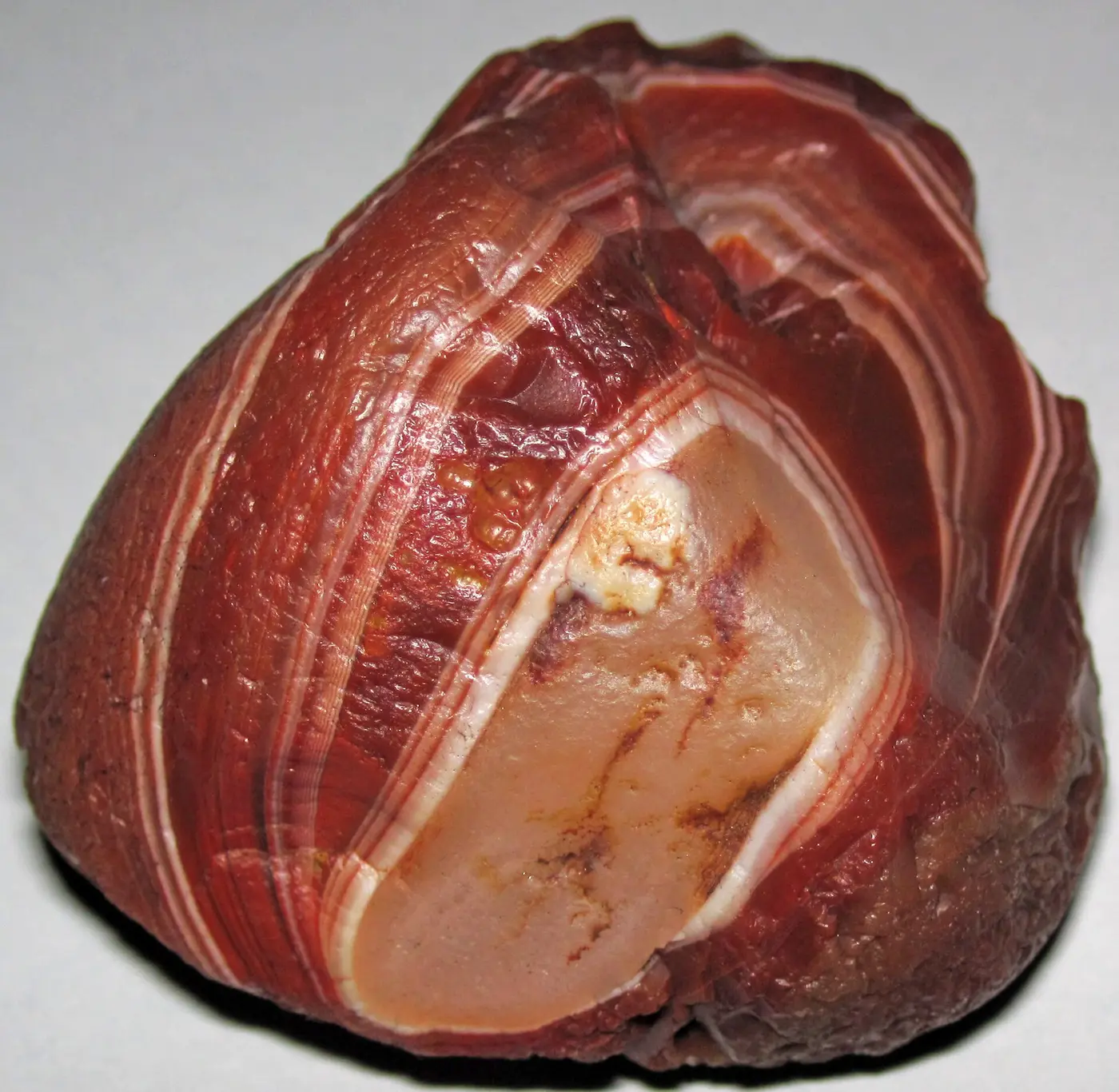
| Stone | How it differs |
|---|---|
| Jasper | Often red too, but opaque: no light passes through, and no bands |
| Carnelian (unbanded red chalcedony) | Translucent and red like agate, but without bands. Still a nice find |
| Quartz “balls” | Mostly coarse, glittery quartz crystals inside instead of fine bands |
| Basalt with amygdules | Dark rock with small light-colored filled holes. The agate may still be inside the rock |
| Banded rhyolite or chert | Can show layers, but opaque and without the waxy translucent look |
What are the main types of Lake Superior agate?
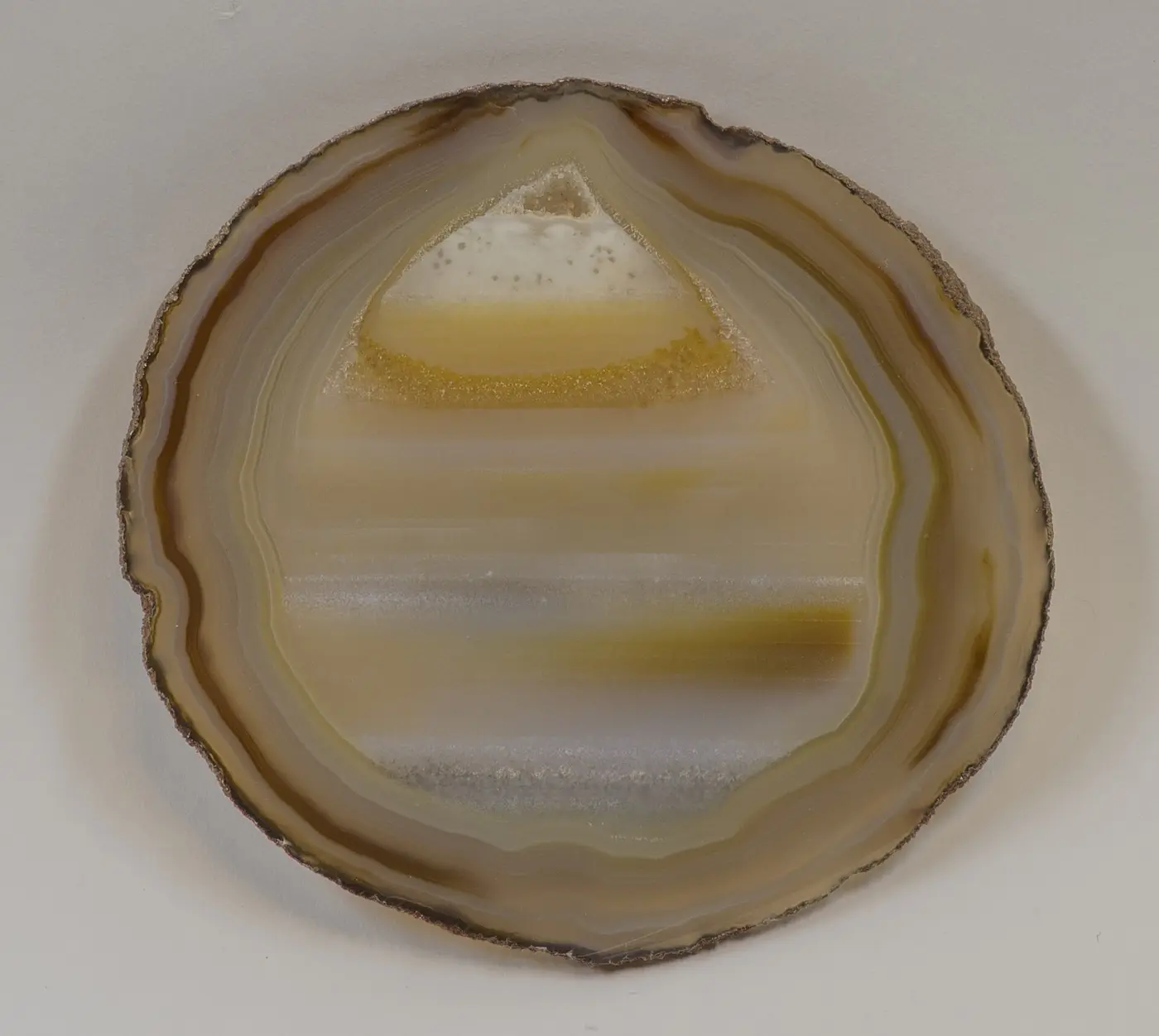
Agates are classified by their band patterns and what’s inside them:
| Type | What it looks like | How common |
|---|---|---|
| Fortification | Concentric bands that follow the shape of the cavity, like the walls of a fort | Most common, and highly sought after |
| Water-level (onyx) | Straight, parallel bands that formed flat, like water in a glass | Common |
| Moss | No bands, with moss-like mineral growths inside | Common |
| Tube | Small tubes running through the bands | Common |
| Paint | Opaque, brightly colored bands that look painted | Common, and among the most valuable |
| Floater | Bands that seem to float in clear quartz | Common |
| Eye | Small round “eyes” of concentric rings on the surface | Uncommon |
| Sagenitic | Needle-like mineral sprays inside | Uncommon |
| Peeler | Outer layers split off by freezing and thawing | Uncommon |
| Copper replacement | Copper fills the bands | Rare. Michigan’s Keweenaw Peninsula is the only place in the world known to produce them |
Where can you find Lake Superior agates?
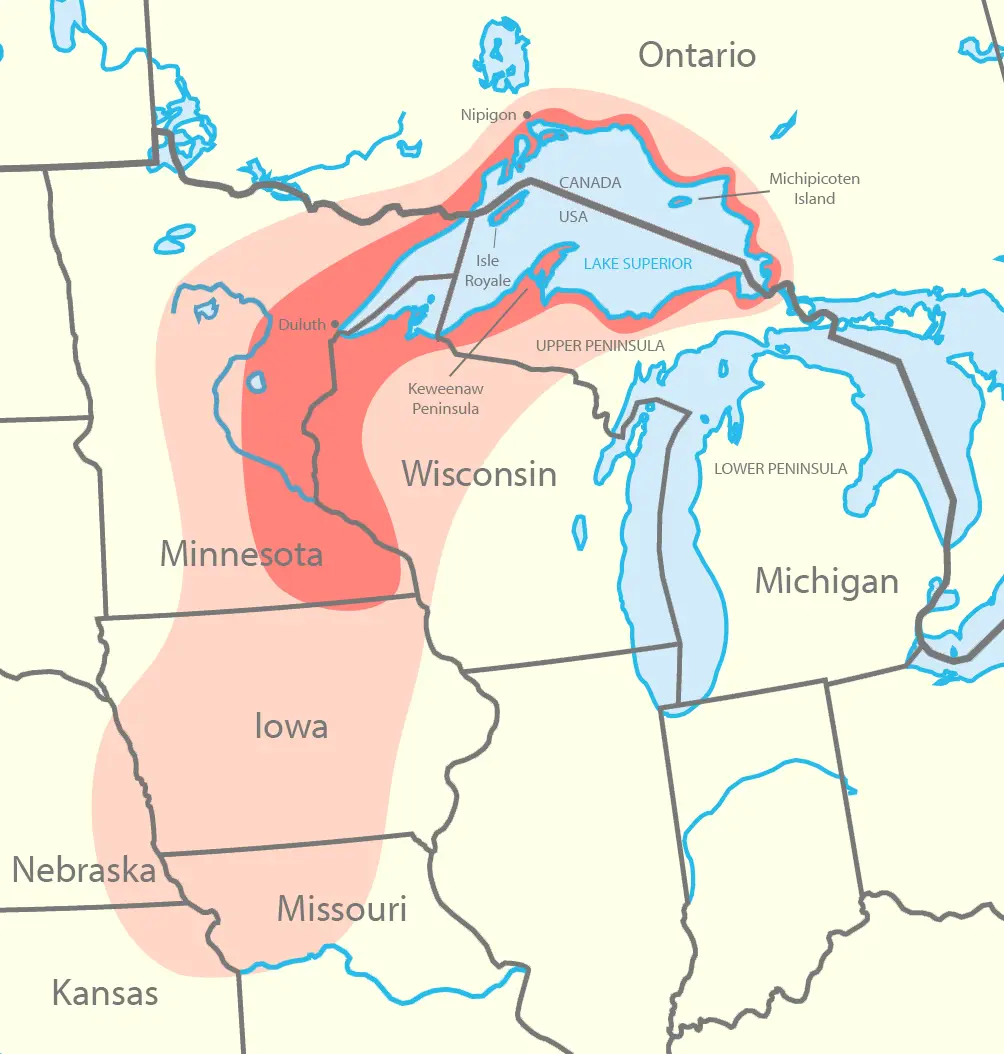
Agates are found all around Lake Superior, but rules vary a lot from one beach to the next (see the next section). In general:
Minnesota (North Shore). Gravel beaches between Duluth and the Canadian border, such as Agate Bay in Two Harbors and Flood Bay. Collecting is not allowed in Minnesota state parks, which include several famous North Shore beaches like Gooseberry Falls. Stick to public beaches outside state parks, and private land with permission.
Michigan (Upper Peninsula). Gravel beaches along the south shore of Lake Superior, especially around Grand Marais (home of a well-known Agate Beach), the Keweenaw Peninsula (for copper replacement agates) and the western UP near Ironwood. Collecting is not allowed inside Pictured Rocks National Lakeshore or Isle Royale National Park.
Wisconsin (South Shore). Gravel beaches along the Lake Superior shore in the northwest of the state. Collecting is not allowed in Apostle Islands National Lakeshore, and Wisconsin state properties have their own rules.
Inland. Because glaciers spread them, agates turn up in gravel pits, gravel roads, farm fields, riverbanks and even landscaping gravel across Minnesota, Wisconsin and beyond. Gravel pits and private fields require the owner’s permission. Moose Lake, Minnesota, calls itself the “Agate Capital of the World” and holds Agate Days every July.
When is the best time to hunt for agates?
- After storms and strong winds. Big waves churn the gravel and bring fresh stones to the surface. Many experienced hunters swear by the first calm day after big waves: the fresh gravel is exposed, and the water is calm enough to search the edge.
- Spring. Winter ice and waves rework the beaches, and fewer people have searched them.
- Off-season and early morning. Popular beaches get picked over quickly in summer.
- Sunny days. Sunlight shining through a stone makes translucent agates glow, which helps you spot them.
Don’t be discouraged
Most agates you’ll find are small, and plenty of trips end with just a few, or none. That’s normal, even for people who’ve hunted for years. Popular beaches get picked over quickly, so try quieter stretches, go early, and come back after the next storm.
Is it legal to collect Lake Superior agates?
Yes in many places, but not everywhere. Rules depend on the state and on who manages the land:
| Where | Rule |
|---|---|
| Minnesota state parks and state scientific and natural areas | Not allowed. The Minnesota DNR says rock collecting isn’t allowed in state parks |
| Michigan state land | Allowed up to 25 lb per person per year in total, for personal, non-commercial hobby use (Michigan Administrative Code R 299.922) |
| Wisconsin state properties | Rules depend on the property, and some sites are closed to collecting. Check with the property before you collect |
| National parks and lakeshores (Isle Royale, Pictured Rocks, Apostle Islands) | Not allowed. Removing rocks is illegal under federal law |
| City and county beaches | Rules vary. Look for posted signs or ask the local parks office |
| Private land, gravel pits | Only with the owner’s permission |
Rules change, and posted signs always win. See our full guide to rock collecting rules.
Are Lake Superior agates worth money?
Most are worth more to the finder than on the market, but large, high-quality agates can sell for hundreds of dollars or more. Value depends on:
- Size. About 95% of agates found are marble-sized or smaller, roughly 5% are ping-pong ball-sized (2 to 4 ounces), and less than 1% weigh over a pound. Every step up in size is much rarer.
- Color and bands. Bright red, orange and yellow, with sharp, high-contrast bands, are worth the most.
- Quality. Few fractures and little coarse quartz in the center.
- Type. Paint agates, eye agates and copper replacement agates are prized by collectors.
- Shape. A whole, naturally rounded stone is worth more than a broken fragment.
Only a small fraction of agates are gem quality. Most collectors keep their finds, tumble them or turn the best ones into jewelry.
Should you polish a Lake Superior agate?
It’s one of the most debated questions among collectors. Many prefer to leave a lake-smoothed agate as it is: the waves already gave it a natural finish, and the outer surface is part of its character. Tumbling or cutting makes more sense for broken pieces, rough agates with a dull surface, or stones where you want to see the bands inside. If you’re unsure, keep your best agates natural and practice on small or broken ones first.
What is the biggest Lake Superior agate ever found?
The largest known Lake Superior agate is displayed in Moose Lake, Minnesota. It’s often reported at 108 pounds, but we couldn’t confirm that weight from an official source, and some collectors question whether the whole stone is agate. Either way, it’s a huge exception: most agates fit in the palm of your hand.
Frequently asked questions
What does LSA mean?
LSA is short for Lake Superior agate. Collectors also call them “Lakers.”
How old are Lake Superior agates?
About 1.1 billion years old, which makes them among the oldest agates in the world.
Why are Lake Superior agates red?
Iron. Iron-rich groundwater left iron oxides (hematite, goethite, limonite) in the bands, giving red, orange and yellow colors.
How rare are Lake Superior agates?
Small agates are fairly common in the right places. Large ones are rare: less than 1% of agates found weigh over a pound.
Can you find Lake Superior agates outside the Lake Superior area?
Yes. Glaciers carried them across the Upper Midwest, into Iowa, Nebraska, Kansas, Missouri and beyond. Gravel pits and gravel roads are good places to look, with permission.
Is it legal to collect agates in Minnesota state parks?
No. The Minnesota DNR says rock collecting isn’t allowed in state parks and state recreation areas.
What makes a Lake Superior agate valuable?
Size, bright color, sharp bands, few fractures and rare types such as paint, eye or copper replacement agates.
Related guides
Sources (9)
- Minnesota Secretary of State, “State Gemstone: Agate”: https://sos.mn.gov/about-minnesota/state-symbols/state-gemstone-agate
- Minnesota Statutes, section 1.147 (official state gemstone): https://www.revisor.mn.gov/statutes/cite/1.147
- Minnesota DNR, “Geology in state parks”: https://www.dnr.state.mn.us/education/geology/digging/stateparks.html
- Minnesota DNR, “Recreational Geology”: https://www.dnr.state.mn.us/geologyrec/index.html
- Minnesota DNR, “Minnesota’s State Gem”: https://www.dnr.state.mn.us/education/geology/digging/agate.html
- Wikipedia, “Lake Superior agate” (geology, varieties, size distribution): https://en.wikipedia.org/wiki/Lake_Superior_agate
- Michigan Administrative Code R 299.922(hh): https://www.law.cornell.edu/regulations/michigan/Mich-Admin-Code-R-299-922
- Pine Knot News, “Agate Days returns” (2022): https://pineknotnews.com/story/2022/07/15/happenings/agate-days-returns/7605.html
- Photo credits (via Wikimedia Commons; some backgrounds removed): Lech Darski (CC BY-SA 4.0); James St. John (CC BY 2.0); Hannes Grobe/AWI (CC BY 3.0); I2Overcome (CC BY 4.0).
Last updated: November 29, 2026. Spotted something out of date? Tell us.