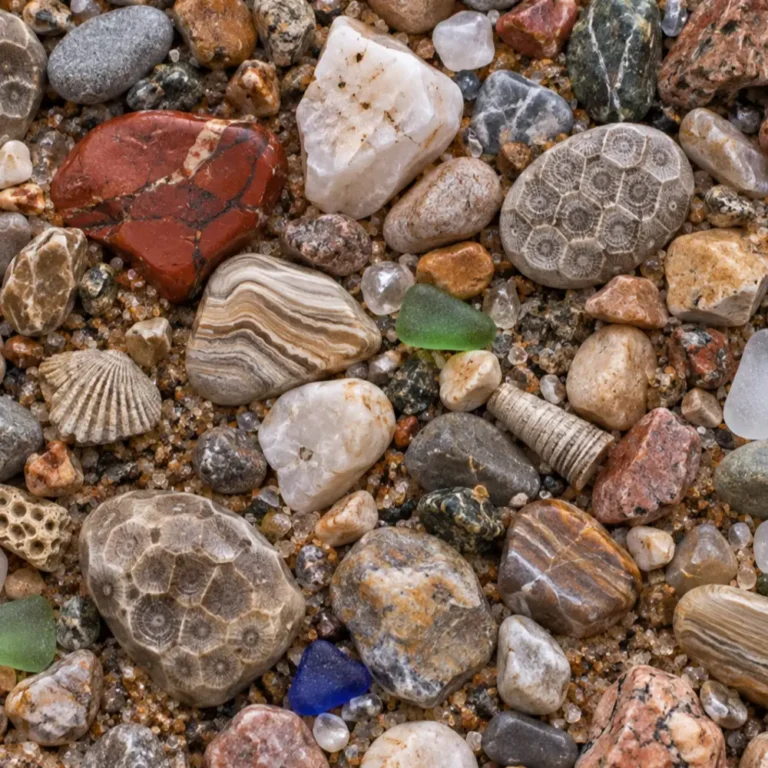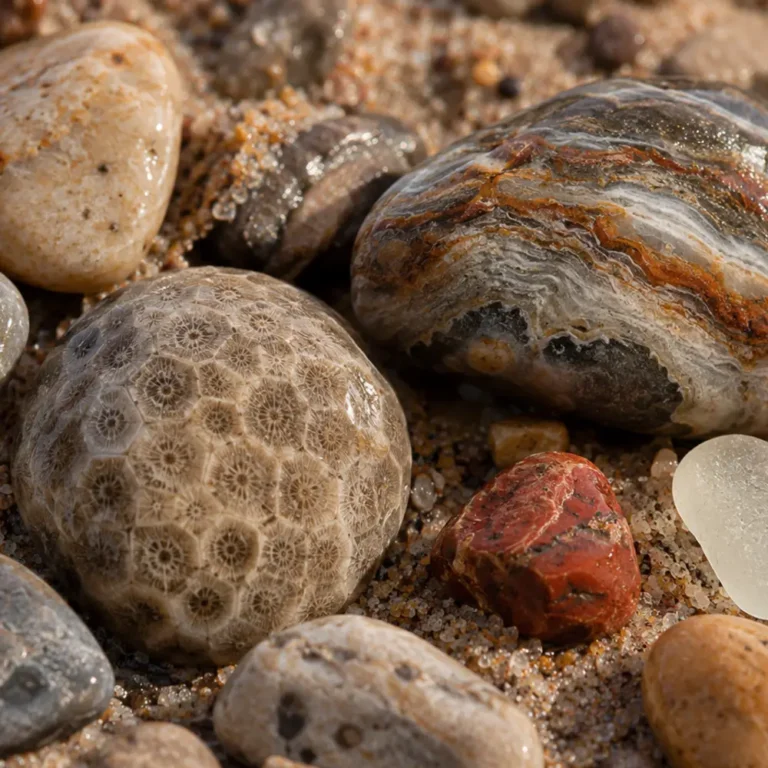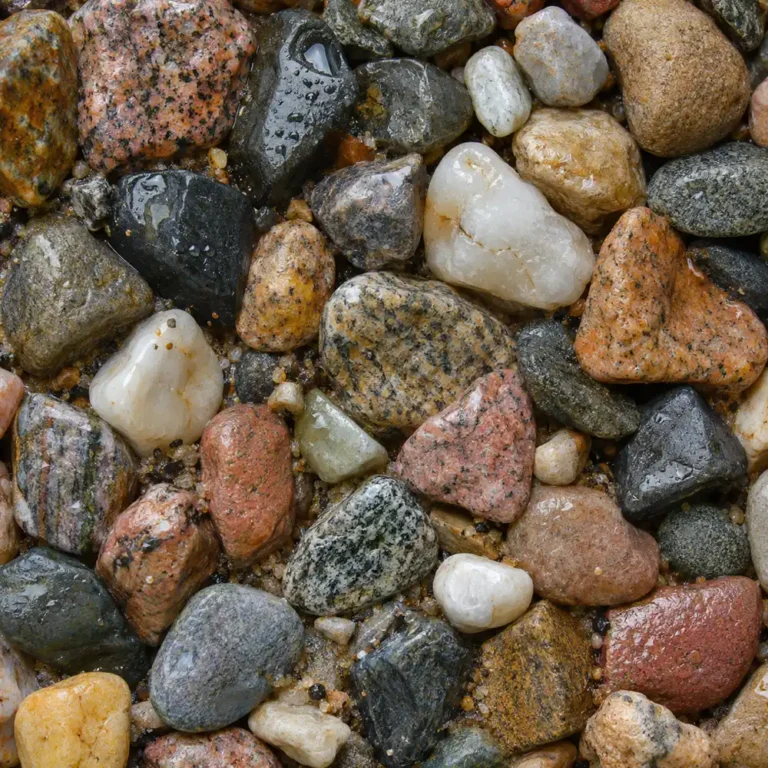
Rockhounding, or rock hunting, is the hobby of finding and collecting rocks, minerals and fossils, and people who do it are called rockhounds. The Great Lakes are one of the best places in North America to start: you don’t need to dig, just walk a rocky beach and pick up what the waves bring in. Start with an easy target, like Petoskey stones on Lake Michigan or beach glass, go after a storm or in spring, wet the stones to see their patterns, and check the collecting rules before you keep anything.
What is rockhounding?
Rockhounding is the hobby of searching for interesting rocks, minerals, gemstones and fossils, usually for a personal collection. A rockhound might walk a beach, check a gravel pit (with permission), split rocks at an old quarry, or polish what they find at home.
On the Great Lakes, rockhounding mostly means beach hunting: walking the shoreline and picking up loose stones. It’s cheap, it’s family-friendly, and you can do it with nothing more than a bucket.
Which stones are easiest to find as a beginner?
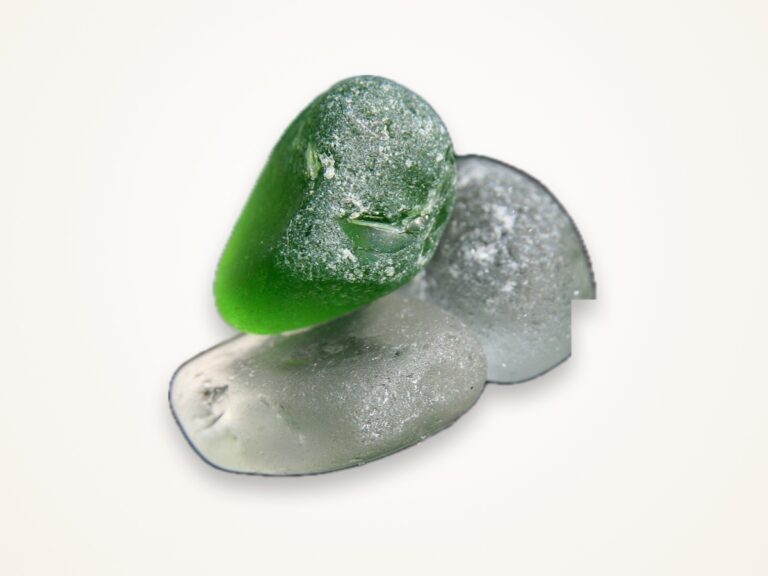
Some Great Lakes finds are much easier than others. Start with the easy ones, then work up.
| Difficulty | Stone | Where | Why |
|---|---|---|---|
| Easy | Beach glass | All five lakes, especially Lake Erie | Easy to spot by its color and frosted look |
| Easy | Crinoid stems and fossil corals | Lake Michigan and Lake Huron | Common on many rocky beaches |
| Easy to medium | Petoskey stone | Northwest Lower Peninsula, Lake Michigan | Common in the right area, but you need to wet the stones to see the pattern |
| Medium | Leland Blue | Around Leland, Michigan | Bright color, but only in one small area |
| Medium | Yooperlites (fluorescent syenite) | Upper Peninsula, Lake Superior | Easy to see at night with the right UV light, nearly invisible by day |
| Harder | Lake Superior agate | Lake Superior, gravel pits | Usually small and easy to confuse with jasper or quartz. Finding your first one is a milestone |
How to start rockhounding in 7 steps
1. Pick a lake and a target stone
Each lake has its specialties. Petoskey stones are on Lake Michigan (and some Lake Huron shores), agates mostly on Lake Superior, beach glass all around, especially on Lake Erie. Knowing what you’re looking for makes a huge difference. Our lake guides help: Lake Michigan and Lake Superior.
2. Learn what it looks like, wet and dry
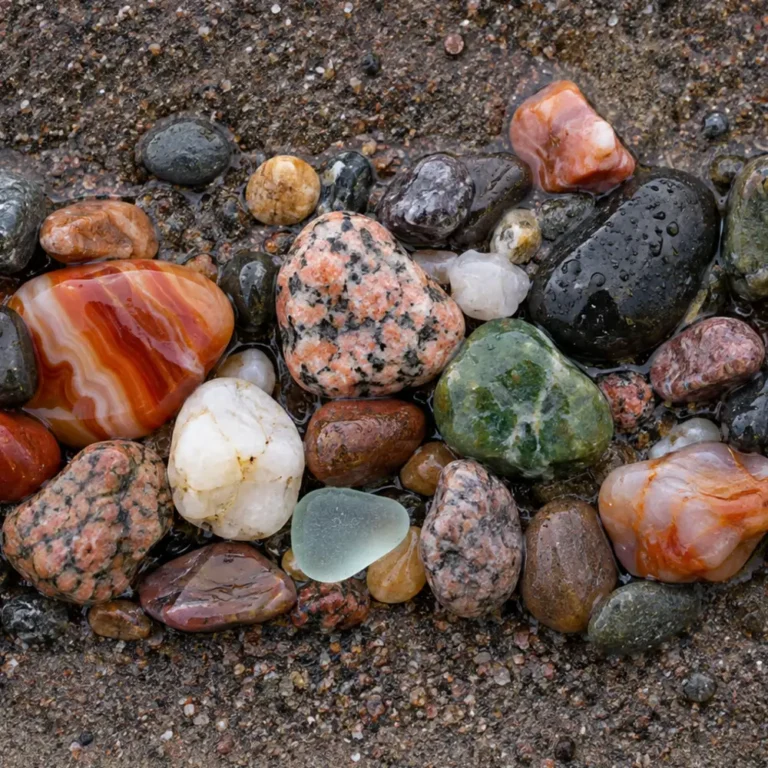
Look at photos of your target before you go, and learn one or two key signs: the six-sided cells with dark “eyes” for a Petoskey stone, bands and translucency for an agate. Most stones look much duller when dry.
3. Choose the right beach
Skip pure-sand beaches: look for gravel and pebble beaches. The most famous spots are often picked over, especially in summer, so quieter stretches nearby can be better. Make sure the beach is public and that collecting is allowed there (step 6).
4. Go at the right time
- Spring, after the ice goes out, when the beaches have been reworked.
- After storms, when big waves bring fresh stones to the surface. Many experienced hunters go the first calm day after big waves.
- Early morning, before other people walk the beach.
- At night with a UV light, if you’re looking for Yooperlites.
5. Bring a few simple things
A bucket or bag, a spray bottle of water, waterproof shoes, layers for the wind and a small magnifying glass. That’s enough. See our full checklist: what to bring rockhounding.
6. Know the rules before you keep anything
- Michigan state land (including state parks): up to 25 lb per person per year, for personal use.
- National parks and lakeshores (Sleeping Bear Dunes, Pictured Rocks, Isle Royale, Apostle Islands, Indiana Dunes): no collecting.
- Minnesota state parks: no rock collecting.
- Private land and gravel pits: only with the owner’s permission.
When in doubt, look for posted signs or ask. See our rock collecting rules.
7. Get help identifying your finds
Lay out your haul at home, wet it and look again. Then compare with good photos, ask a local rock club, or visit a museum like the A. E. Seaman Mineral Museum in Houghton, Michigan. Be wary of websites that talk about the “healing powers” of stones: they won’t help you identify anything.
Common beginner mistakes
| Mistake | What to do instead |
|---|---|
| Looking at dry stones | Wet them: patterns and colors appear |
| Expecting Petoskey stones on Lake Superior | Petoskeys are on Lake Michigan and Lake Huron; Lake Superior is for agates |
| Going to the most famous beach in July | Try quieter stretches, early mornings or the off-season |
| Buying a cheap UV flashlight | Get a filtered 365 nm light; cheap ones often show nothing |
| Taking rocks in a national park or lakeshore | Leave them: it’s illegal under federal law |
| Tumbling soft stones like Petoskeys with hard ones | Polish soft stones by hand, or tumble them separately |
| Mistaking glowing glass for a Yooperlite | Glowing beach glass is usually old glass made with uranium (bright green glow) or manganese (weak glow); Yooperlites glow orange |
| Thinking you failed because you found little | Small hauls are normal, even for experienced hunters |
What to expect on your first trips
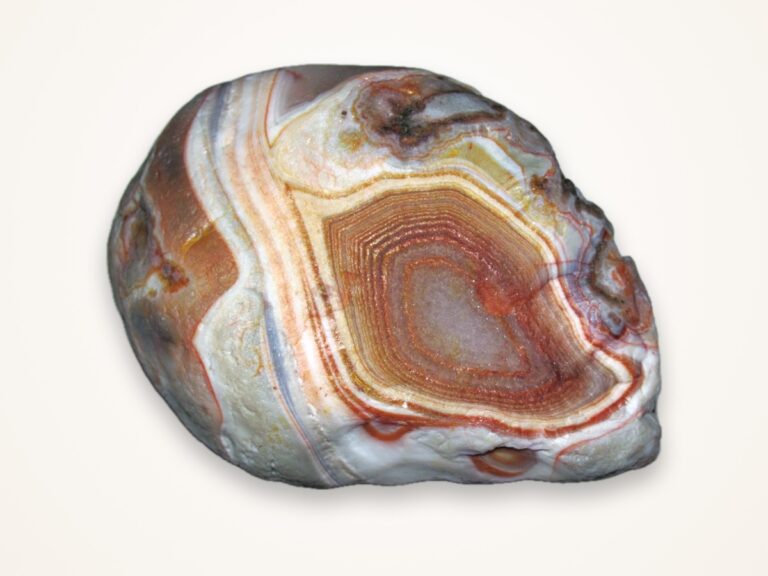
Honestly: you’ll bring home a lot of pretty granite, basalt and jasper, and maybe one or two of the stones you were hoping for. That’s how almost everyone starts. Rockhounds talk about learning to “see” the stones: after a few trips, your eye gets trained and patterns start jumping out. Many people say the best part is the time on the beach itself, often with family.
Rockhound vocabulary: the words you’ll hear
| Word | Meaning |
|---|---|
| Rockhound | Someone who collects rocks as a hobby |
| Rock hunting | Another name for rockhounding, often used by casual collectors |
| Haul | Everything you found on a trip |
| Picked over | A beach that many people have already searched |
| LSA / Laker | Lake Superior agate |
| Fortification, eye, water-level | Types of agate patterns |
| Pounder | An agate weighing a pound or more |
| Yooper / the UP | Someone from / Michigan’s Upper Peninsula |
| Frosty | Beach glass with a well-frosted surface |
| Stage, grit | Steps and abrasives used when tumbling or polishing |
| Scoop | A long-handled sieve for picking stones from the water |
Frequently asked questions
What is rockhounding?
The hobby of finding and collecting rocks, minerals and fossils. On the Great Lakes, it mostly means picking up interesting stones on the beach.
What does a rockhound do?
A rockhound searches for interesting rocks, identifies them, and often collects, displays or polishes them.
Is rockhounding legal?
Yes in many places, with limits. On Michigan state land you can keep up to 25 lb per year. It’s not allowed in national parks and lakeshores or in Minnesota state parks, and you need permission on private land.
Where is the best place to start rockhounding on the Great Lakes?
A rocky public beach on Lake Michigan in the northwest Lower Peninsula (for Petoskey stones and fossils), or on Lake Superior in Michigan’s Upper Peninsula (for agates), outside national lakeshores and state parks where collecting is restricted.
Do I need special tools to start rockhounding?
No. A bucket, a spray bottle, good shoes and a small magnifying glass are enough on the beach.
What’s the best time of year for rockhounding on the Great Lakes?
Spring, after the ice goes out, and right after storms. Early mornings help on popular beaches.
Related guides
Sources (7)
- Michigan Administrative Code R 299.922: https://www.law.cornell.edu/regulations/michigan/Mich-Admin-Code-R-299-922
- Minnesota DNR, “Geology in state parks”: https://www.dnr.state.mn.us/education/geology/digging/stateparks.html
- National Park Service, Sleeping Bear Dunes, “Beaches”: https://www.nps.gov/slbe/learn/nature/beaches.htm
- National Park Service, Apostle Islands, “Laws & Policies”: https://www.nps.gov/apis/learn/management/lawsandpolicies.htm
- National Park Service, Indiana Dunes, “Know Before You Go: Rules for Natural Items”: https://www.nps.gov/indu/learn/management/naturalitems.htm
- Michigan Geological Survey (WMU), MGS Rockhounds: https://mgs.wmich.edu/education-and-outreach/corekids/mgs-rockhounds/
- Photo credits (via Wikimedia Commons; some backgrounds removed): Larsgl (public domain); James St. John (CC BY 2.0).
Last updated: November 29, 2026. Spotted something out of date? Tell us.