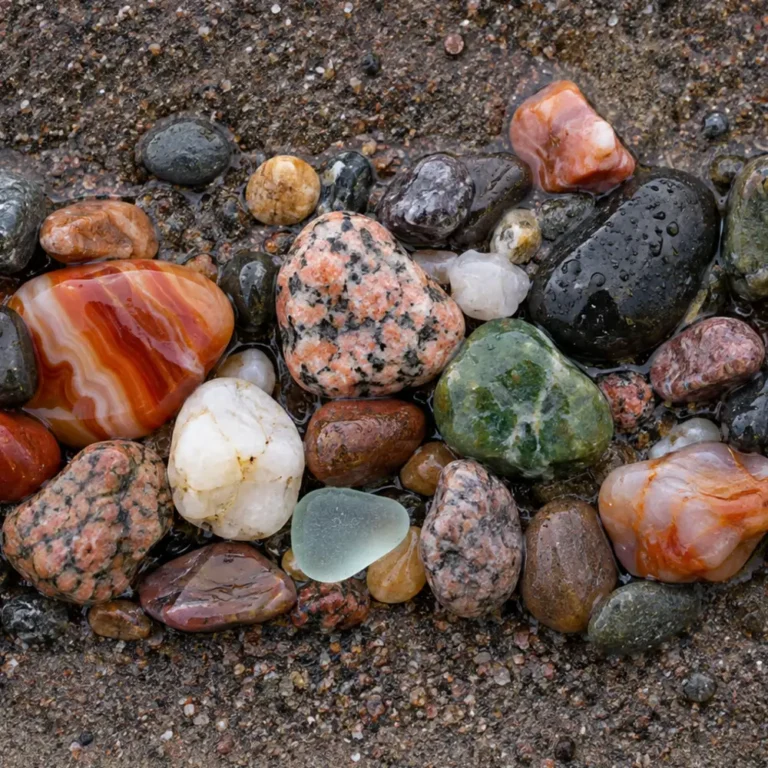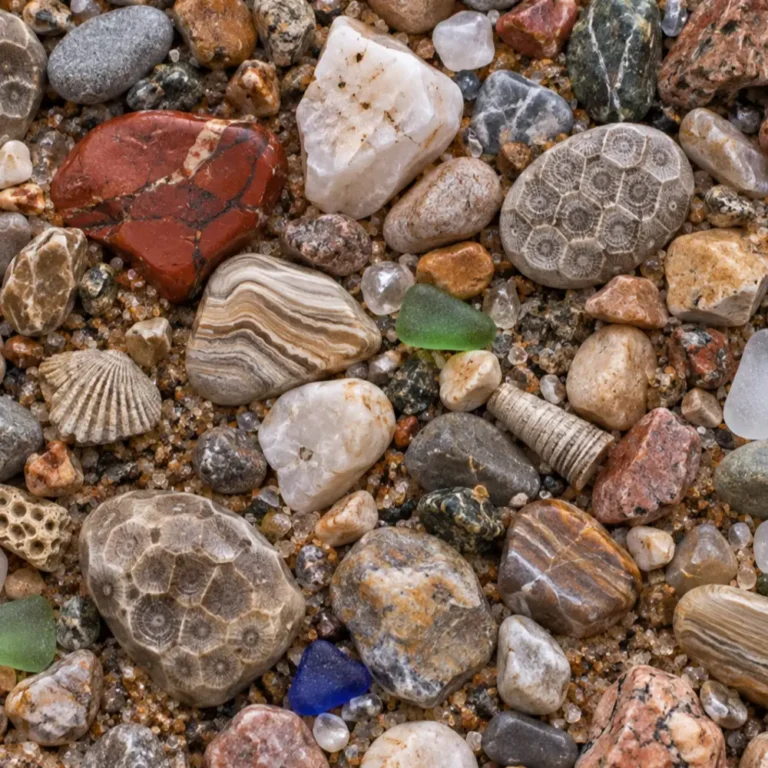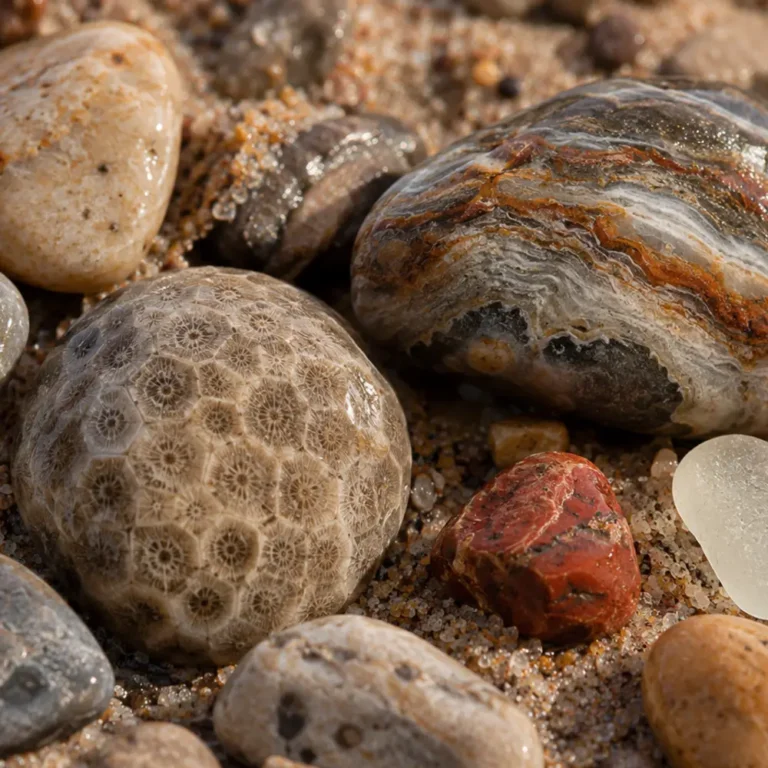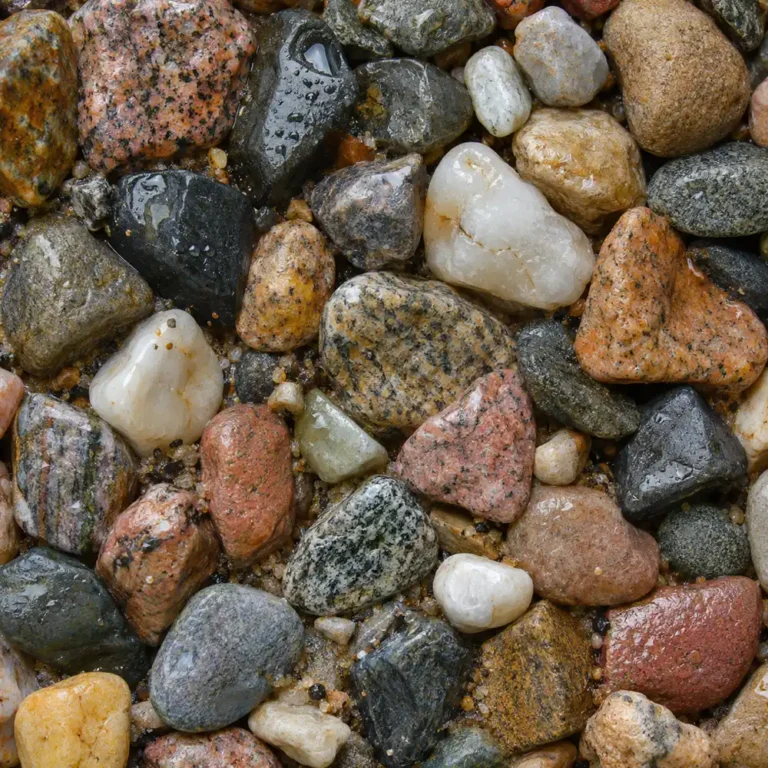
Beach glass is old glass (bottles, jars, dishes) that waves and sand have broken, smoothed and frosted over decades. On the Great Lakes it’s called “beach glass” because it comes from fresh water, while “sea glass” comes from the ocean. Lake Erie is the best-known Great Lakes beach glass destination, but you can find it on all five lakes. Most pieces are white, brown or green; red, orange and yellow are extremely rare.
| Quick facts | |
|---|---|
| What it is | Discarded glass smoothed and frosted by waves and sand |
| Beach glass vs sea glass | Beach glass = fresh water (lakes, rivers); sea glass = salt water |
| How long it takes | Usually estimated at 20 to 50 years, sometimes much longer |
| Best-known lake | Lake Erie (Pennsylvania and Ohio shores) |
| Most common colors | Clear/white, brown, kelly green |
| Rarest colors | Red, orange, yellow, turquoise, black |
| Glows under UV? | Some does: uranium glass glows bright green, manganese glass a weak greenish-yellow |
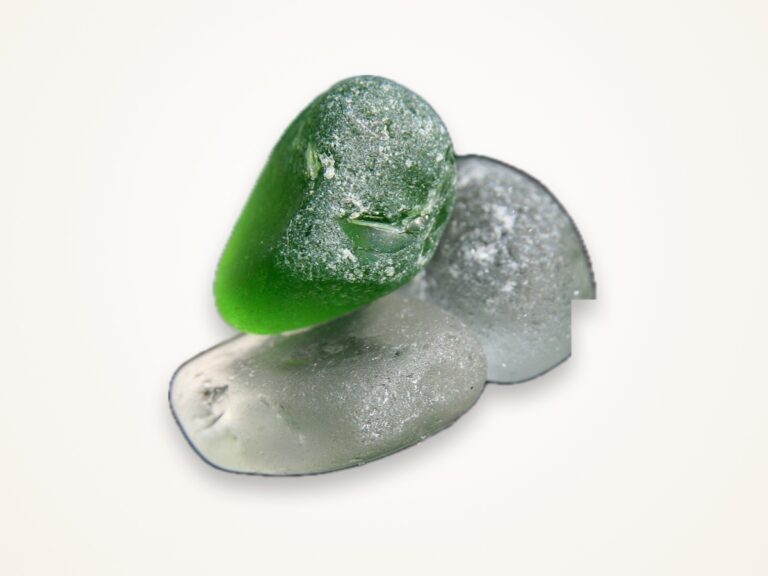
What is beach glass?
Beach glass starts as ordinary trash: bottles, jars, tableware and window glass thrown away or lost decades ago. Once in the water, it breaks into pieces, and waves tumble those pieces against sand and stones. Over the years, the sharp edges round off and the surface turns frosted.
How does beach glass get frosted?
Two things work together:
- Abrasion: waves rub the glass against sand and gravel, smoothing its edges.
- Chemistry: water slowly leaches some of the ingredients of the glass (soda and lime) out of its surface, leaving a frosted, pitted finish.
This takes a long time: estimates usually range from 20 to 50 years, and some pieces are much older.
Why is Great Lakes beach glass often less frosted?
Freshwater beach glass is often less frosted than ocean sea glass. A likely reason: ocean water contains far more chloride than fresh water, which makes it more corrosive to glass. So a piece of lake glass can be old and still look glossier than a sea glass piece of the same age.
Where does Great Lakes beach glass come from?
For generations, the Great Lakes shorelines served as dumping grounds, and glass from shipwrecks, littering, coastal dumping, storm runoff and erosion ended up in the water. The trash broke down; the glass remained.
That supply is shrinking. Recycling and dumping laws have reduced the amount of new glass reaching the lakes, and popular beaches are heavily searched, so good pieces are harder to find than they were a few decades ago.
Where to find beach glass on the Great Lakes
| Lake | What to know |
|---|---|
| Lake Erie | The most famous for beach glass. Popular areas include Presque Isle (Erie, Pennsylvania) and Ohio beaches such as Conneaut, Huntington and Edgewater (Cleveland). Presque Isle is heavily searched |
| Lake Michigan | Beach glass mixed with stones and fossils, including on Chicago-area and Michigan beaches |
| Lake Ontario | A well-known beach glass lake among collectors |
| Lake Huron and Lake Superior | Less glass overall, but pieces turn up near old towns and harbors |
When to go:
- After storms and windy nights, when waves bring new pieces up the beach.
- Early in the morning, before other collectors.
- In the cold season. Dedicated “glassers” hunt year-round, even in winter, and fall is a busy season for finds and posts.
Look at the wet line and in the gravel bands, where small, heavy objects collect.
Beach glass colors: common to extremely rare
Color rarity tells you a lot about a piece’s age and origin. Here’s the rarity scale used by most collectors, based on Richard LaMotte’s identification work:
| Rarity | Colors | Where they came from |
|---|---|---|
| Common | Clear/white, brown, kelly green | Everyday bottles and jars |
| Uncommon | Seafoam, soft blue, forest green, amber | Older soda and medicine bottles, window glass |
| Rare | Cobalt blue, cornflower blue, pink, purple, aqua, citron | Medicine bottles, tableware, old glass that changed color in the sun |
| Extremely rare | Red, orange, yellow, turquoise, teal, gray, black | Decorative glass, lamps, signal lights, very old dark bottles |
Why some colors are rare:
- Red was once made with expensive gold; cheaper copper-based reds came later.
- Cobalt produces very dark blue, and iron gives greens.
- Purple and pink: old clear glass decolorized with manganese slowly turns purple in the sun. By the 1920s, selenium replaced manganese, and old selenium glass can turn yellowish in the sun.
On Lake Erie, collectors describe pinks, yellows, oranges and reds as very rare. Estimates of exactly how rare vary: one well-known figure is about 1 red piece in 5,000.
Beach glass that glows under UV light
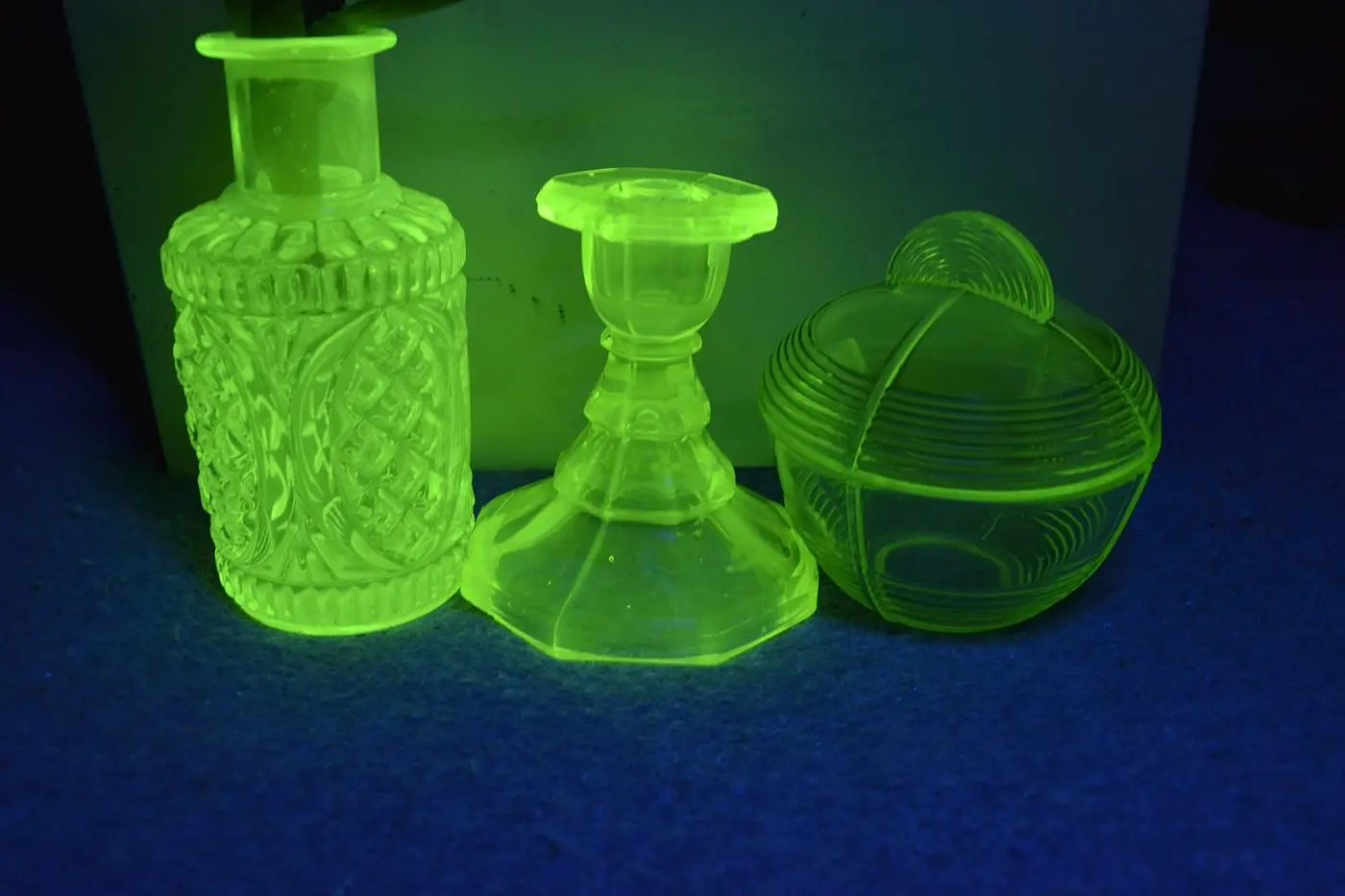
If you shine a UV flashlight on beach glass at night, some pieces may glow:
| Glass | What it does under UV | What it is |
|---|---|---|
| Uranium glass (“vaseline glass”) | Very strong, bright green glow | Glass colored with uranium, made from the 1830s, most popular in the late 1800s and early 1900s, much rarer after World War II |
| Manganese glass | Weak, “lemonade-like” greenish-yellow glow | Old clear glass decolorized with manganese, common before the 1920s |
Is uranium beach glass dangerous? Its radioactivity is generally considered very low and not harmful with normal handling. Don’t use uranium glass for food or drink.
Glowing glass is not a Yooperlite. Yooperlites are stones (syenite containing fluorescent sodalite) that glow orange, not green.
How to tell old glass from new
- Mold seams: on bottle pieces, a seam running all the way to the top of the lip usually means a machine-made bottle, from roughly 1900–1910 or later.
- Pontil scars: a rough round mark on the base means the bottle was finished by hand, which points to older glass.
- Embossing: letters or logos can help identify the maker and age.
- Color: purple-tinted clear glass suggests manganese, typically before the 1920s.
Other treasures turn up too: old marbles (rare on Lake Erie beaches), bottle stoppers, and pottery shards.
Real or fake beach glass?
“Artificial” sea or beach glass is glass that has been machine tumbled, sandblasted or acid-etched to look old. It’s sold in craft stores and online. Signs of a fake:
- Perfectly uniform frosting all over;
- No natural pitting or wear;
- Identical shapes and sizes in a batch.
Genuine beach glass is found in lakes, rivers and oceans, and every piece wears differently.
How to clean beach glass
Use lukewarm water with a drop of mild dish soap and a soft brush. Avoid harsh dishwasher detergents, bleach and acids, which can damage the surface. Let it air dry.
Can you collect beach glass on the Great Lakes?
It depends on where you are, and rules for glass are often less clear than for rocks.
| Where | What we know |
|---|---|
| Indiana Dunes National Park | The park bans collecting rocks, fossils, sand and occupied shells; its rules don’t mention glass. A 2022 news report said the park allowed taking worn glass as trash. Ask a ranger before you collect |
| Indiana Dunes State Park | The same 2022 report said Indiana state parks don’t allow it |
| Other national parks and lakeshores (Sleeping Bear Dunes, Pictured Rocks, Apostle Islands) | They prohibit removing natural features; glass isn’t addressed explicitly. Ask before collecting |
| State parks in Ohio, Pennsylvania and Michigan | We haven’t found an official rule that specifically mentions beach glass. Check with the park office |
| City beaches | Rules vary. Look for posted signs |
| Private beaches | Only with the owner’s permission |
Great Lakes beach glass festivals
- Great Lakes Beach Glass & Coastal Arts Festival, Erie, Pennsylvania (Bayfront Convention Center), usually held in October.
- Ashtabula Harbor Beach Glass Festival, Ashtabula, Ohio, held since 2010, usually in summer.
Check the organizers’ websites for current dates.
Frequently asked questions
What is beach glass?
Old glass from bottles, jars and dishes that waves and sand have smoothed and frosted over decades. On fresh water it’s called beach glass; on salt water, sea glass.
How is beach glass made?
Waves break discarded glass and tumble it against sand and stones, rounding the edges. Water slowly leaches chemicals out of the surface, which gives it a frosted look. This usually takes 20 to 50 years or more.
Where does beach glass come from?
Mostly from old trash: bottles, jars and tableware dumped along shorelines or lost from ships, plus glass washed in by storms and erosion.
What color beach glass is the rarest?
Red, orange, yellow, turquoise and black are among the rarest. White, brown and green are the most common.
Why does some beach glass glow under a black light?
It contains uranium (bright green glow) or manganese (weak greenish-yellow glow). Both were used in old glassmaking.
Where can I find beach glass in Michigan?
On many Lake Michigan and Lake Huron beaches, especially near old towns and harbors, after storms and early in the morning.
Is Great Lakes beach glass real sea glass?
It’s the freshwater version. Collectors usually call it beach glass, and it’s often less frosted than ocean sea glass.
Related guides
Sources (14)
- Corning Museum of Glass, glass colors and decolorizers: https://libanswers.cmog.org/faq/143744 and https://libanswers.cmog.org/faq/144135
- Corning Museum of Glass, glass under UV light (uranium and manganese): https://libanswers.cmog.org/faq/143932
- Oak Ridge Associated Universities, “A Glowing Review of Uranium Glass” (2025): https://orau.org/blog/museum/a-glowing-review-of-uranium-glass.html
- Beachcombing Magazine (Richard LaMotte), “The Science of Sea Glass”: https://www.beachcombingmagazine.com/blogs/news/the-science-of-sea-glass
- Beachcombing Magazine (Ann Fisk), “The Colors and Rarity of Sea Glass” (2023): https://www.beachcombingmagazine.com/blogs/news/the-colors-and-rarity-of-sea-glass
- Great Lakes Now, “Great Lakes sea glass” (2022): https://www.greatlakesnow.org/2022/06/great-lakes-sea-glass/
- The Allegheny Front, “How to find beach glass on Lake Erie” (2026): https://www.alleghenyfront.org/how-to-find-beach-glass-lake-erie/
- International Sea Glass Association, “Genuine vs. Artificial”: https://seaglassassociation.org/genuine-vs-artificial/
- Society for Historical Archaeology, Historic Glass Bottle Identification: https://sha.org/bottle
- Canadian Conservation Institute, cleaning guidance (2018)
- National Park Service, Indiana Dunes, “Know Before You Go: Rules for Natural Items”: https://www.nps.gov/indu/learn/management/naturalitems.htm
- Inkfree News, “What To Know About Beachcombing In Michiana Parks” (2022): https://www.inkfreenews.com/2022/07/11/what-to-know-about-beachcombing-in-michiana-parks/
- Wikipedia, “Sea glass”: https://en.wikipedia.org/wiki/Sea_glass
- Photo credits (via Wikimedia Commons; some backgrounds removed): Larsgl (public domain); Łukasz Karolewski (CC BY-SA 4.0).
Last updated: November 29, 2026. Spotted something out of date? Tell us.