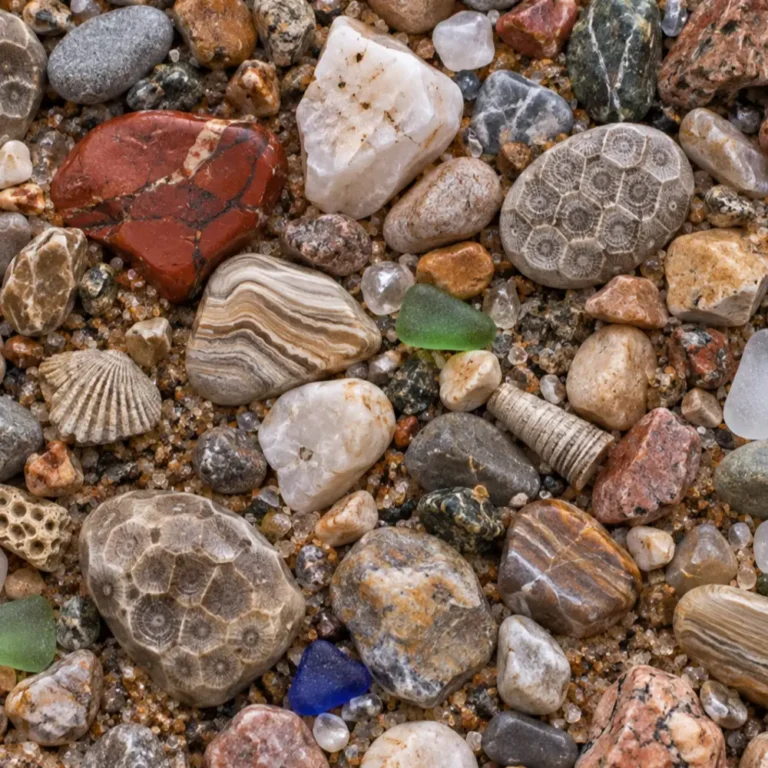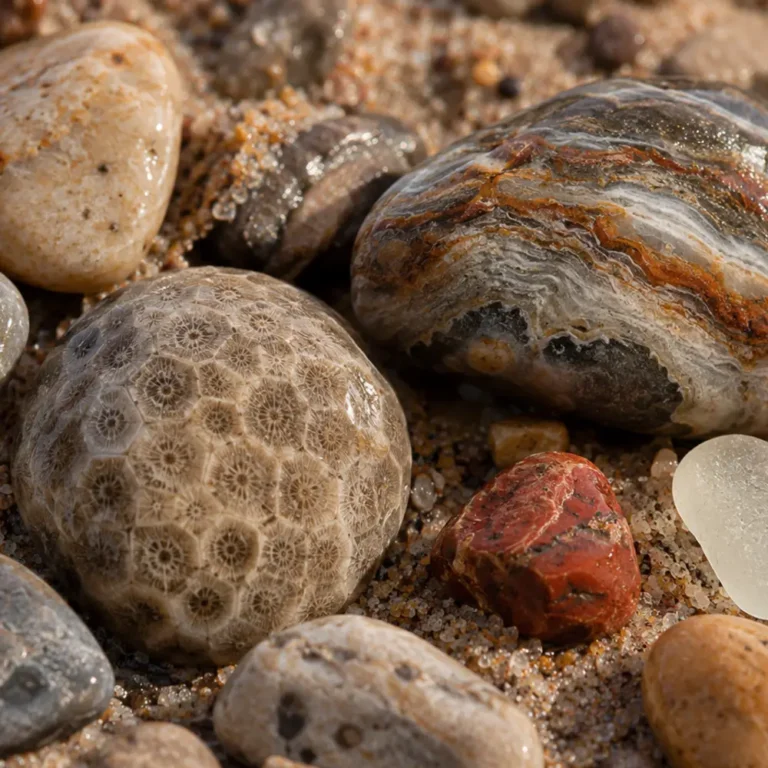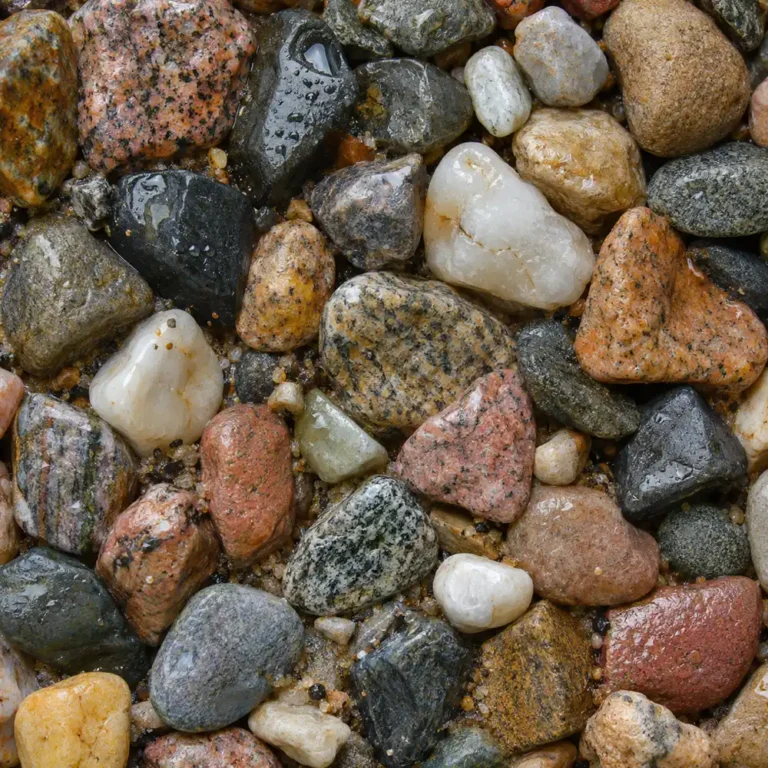
A Yooperlite is a gray syenite stone containing fluorescent sodalite that glows bright orange-yellow under a longwave (365 nm) UV flashlight. In daylight it looks like an ordinary granite-like pebble. They’re found mainly on the Lake Superior beaches of Michigan’s Upper Peninsula (the “U.P.”, home of the “Yoopers”), and people hunt them at night. The name dates from 2017; the stones themselves are glacial pebbles that most likely came from Ontario.
| Quick facts | |
|---|---|
| What it is | Syenite (a granite-like rock) containing fluorescent sodalite |
| In daylight | Gray, speckled, looks like granite |
| Under UV light | Bright orange-yellow glow under longwave (365 nm) UV |
| Glows without UV? | No. The glow stops as soon as the light is off |
| Where | Lake Superior shore of Michigan’s Upper Peninsula, especially from Whitefish Point west |
| Most likely origin | The Coldwell Alkaline Complex near Marathon, Ontario, carried by glaciers |
| Named | 2017, by Michigan rock dealer Erik Rintamaki |
| Best time | At night, especially in spring and fall |
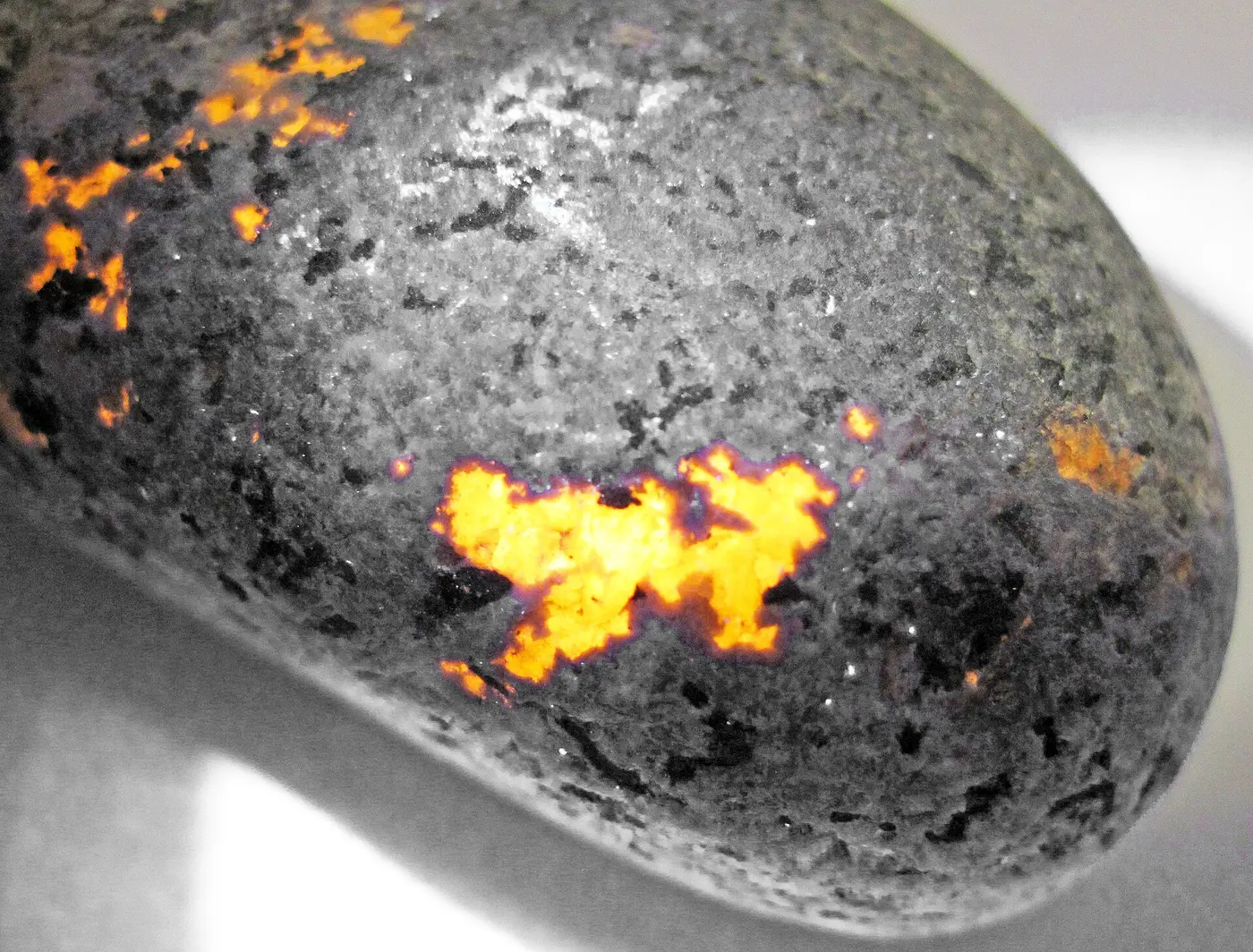
What is a Yooperlite?
Geologically, a Yooperlite is a fluorescent sodalite-bearing syenite. Syenite is an igneous rock similar to granite but with little or no quartz; these pebbles are made mostly of feldspar and nepheline, with a small amount of fluorescent minerals. The glowing mineral is sodalite, and the orange-fluorescing variety is often identified as hackmanite, a sulfur-bearing sodalite.
“Yooperlite” is not an official mineral name. It’s a nickname, coined from “Yooper” (someone from Michigan’s Upper Peninsula). A 2018 paper in Mineral News described the find as fluorescent sodalite from Michigan’s Upper Peninsula, the first verified sodalite in Michigan.
Why do Yooperlites glow?
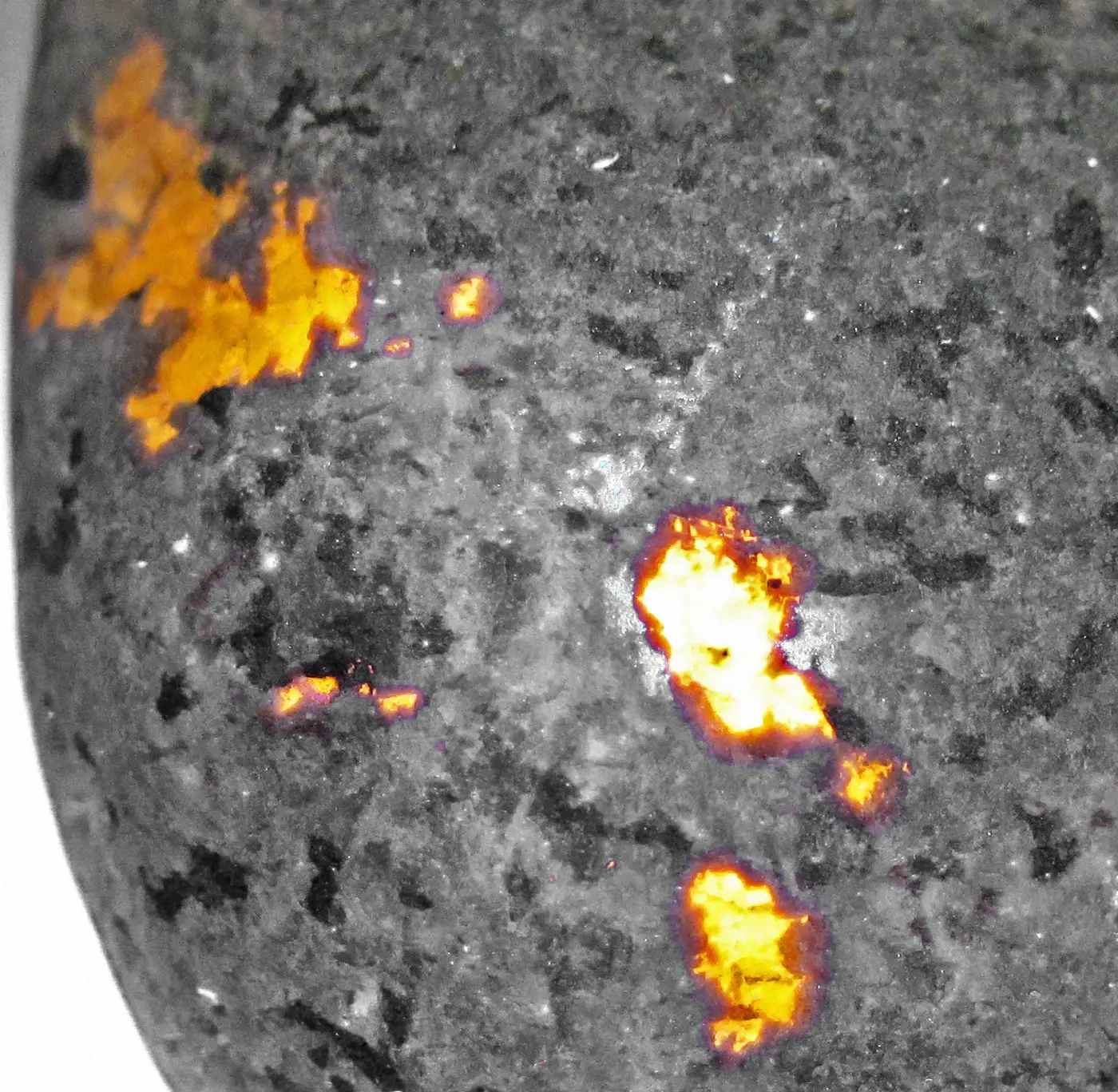
The sodalite in the stone is fluorescent: it absorbs invisible ultraviolet light and gives it back as visible light. Under a longwave UV light (365 nm), Yooperlites glow a strong orange-yellow. The rest of the stone stays dark, so the glowing sodalite shows up as bright patches, veins or speckles.
- No UV, no glow. Yooperlites don’t glow in daylight or in the dark on their own, and they stop glowing the moment you switch off the light.
- Longwave works best. Under shortwave UV, the response is different (sources describe it as weaker or more reddish). Hobby flashlights are longwave.
- It’s fluorescence, not radioactivity. The glow is a reaction to UV light. It’s a completely different phenomenon from radioactivity.
What do Yooperlites look like in daylight?
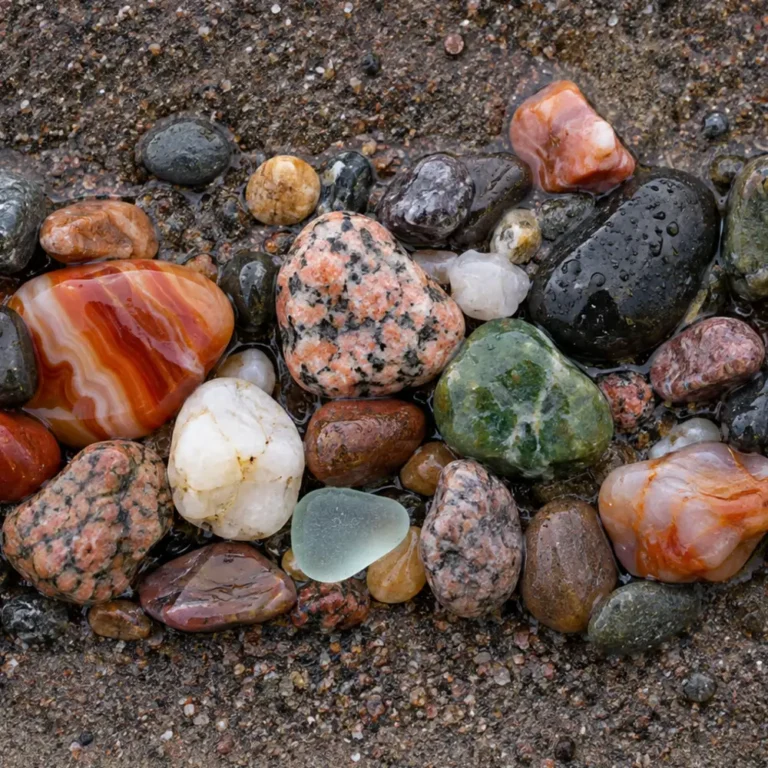
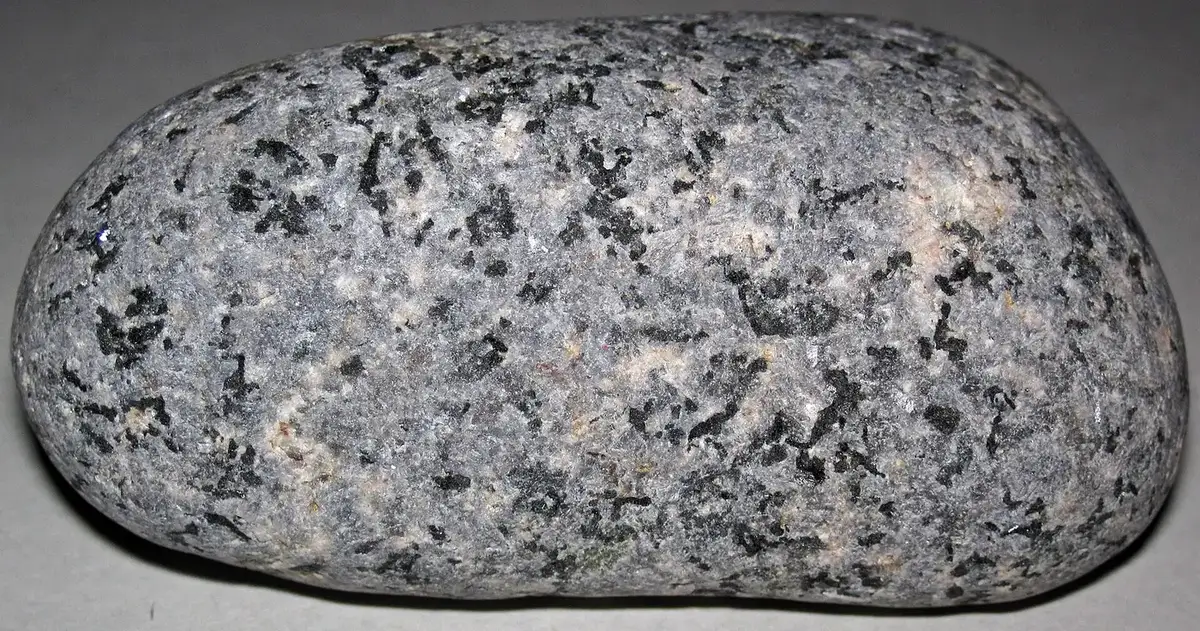
In normal light, a Yooperlite looks like a gray, speckled, granite-like stone, often with darker gray or bluish-gray patches where the sodalite is. That’s why almost nobody noticed them before people started walking the beaches with UV lights: during the day, they blend in with millions of other pebbles.
Where did Yooperlites come from?
The stones aren’t from Michigan. The most likely source is the Coldwell Alkaline Complex, a body of syenite near Marathon, Ontario, on the north shore of Lake Superior, where fluorescent hackmanite was documented long before 2017. During the Ice Age, glaciers moving south broke off pieces of this rock and carried them across the lake, leaving them in the gravel of Michigan’s shores. The Coldwell origin is considered probable, not proven.
Who discovered Yooperlites?
The stones were known to geologists, but nobody had noticed them on Michigan’s beaches. In 2017, Michigan rock and gem dealer Erik Rintamaki found glowing pebbles on a Lake Superior beach with a UV flashlight, had them analyzed (with help from Michigan Tech), and named them “Yooperlites.” Viral videos then turned night hunting into one of the most popular rockhounding activities in the Upper Peninsula.
The name was registered as a federal trademark in 2019, but that registration was cancelled in November 2025.
Where can you find Yooperlites?
Michigan’s Upper Peninsula, Lake Superior shore. This is the classic area: pebble beaches from Whitefish Point west, including the Grand Marais area and, according to the A. E. Seaman Mineral Museum, the Keweenaw shore from Copper Harbor to Ontonagon. Large finds have been reported in Houghton County.
Elsewhere. Glaciers spread these pebbles widely. Researchers have reported fluorescent sodalite in shoreline sediment along the southern Great Lakes from Michigan to New York, including Lake Erie and Lake Ontario. Collectors also report occasional finds in Minnesota, Wisconsin and on Lake Michigan, but they’re much less common than on Michigan’s Lake Superior shore.
Where you can’t collect:
- Pictured Rocks National Lakeshore (between Munising and Grand Marais): collecting rocks is illegal under federal law.
- Whitefish Point unit of the Seney National Wildlife Refuge: rock collecting is prohibited, and the area is open in daylight only.
- Private beaches: only with the owner’s permission.
How to find Yooperlites, step by step
1. Get the right light: a filtered 365 nm longwave UV flashlight (see below).
2. Pick a pebble beach on Lake Superior’s Michigan shore, where collecting is allowed and open at night.
3. Go after dark. The darker, the better: moonless nights make the glow easier to spot.
4. Sweep the light slowly over the stones, holding it fairly close to the ground.
5. Turn the stones. The sodalite may be on only one side, so a small rake or your foot helps.
6. Check your finds in daylight too: you’ll see the gray, speckled stone that was hiding the glow.
When: early spring is considered prime time, after winter storms and ice have brought fresh stones to the beach. Fall is good too. Summer nights are busy on the best-known beaches.
Can you find Yooperlites during the day?
It’s much harder. Sunlight washes out the glow, so you’d have to shade the stones and hold a strong UV light very close. Nearly everyone hunts at night.
The right UV flashlight
- Choose 365 nm. Yooperlites fluoresce strongly under longwave UV at 365 nm. Many cheap “black lights” are 395 nm, which also give off a lot of visible violet light that drowns out the glow.
- Choose a filtered light. A filter (often a dark lens) blocks most of the visible light, so the orange glow stands out.
- Protect your eyes. Michigan’s EGLE recommends UV-protective safety glasses, and never shining the light toward anyone’s eyes.
Rules for night hunting and collecting
| Where | What to know |
|---|---|
| Michigan state land | You can collect up to 25 lb per person per year in total (rocks, minerals and invertebrate fossils), for personal, non-commercial use |
| Michigan state parks at night | Day-use areas are normally open 8 a.m. to 10 p.m. Check each park’s hours before a night hunt |
| Muskallonge Lake State Park | In 2023, the DNR approved opening the Lake Superior parking lot and day-use area 24 hours a day for Yooperlite collecting, with quiet hours from 10 p.m. to 8 a.m. Confirm it’s still in effect before you go |
| Pictured Rocks National Lakeshore | No collecting |
| Whitefish Point (Seney NWR unit) | No rock collecting, daylight only |
| Private beaches | Only with permission |
See our full rock collecting rules.
Night safety
- Never go alone, and tell someone where you’ll be.
- Bring a regular headlamp to walk between searches: UV light doesn’t light the path.
- Watch the waves. Lake Superior is cold and dangerous. Stay off the beach in high waves and storms.
- Dress warmly. Beach nights are cold, even in summer.
- Respect quiet hours and private property.
Are Yooperlites worth money?
Most Yooperlites are worth more as a fun find than on the market. There’s no official valuation: prices online depend on size, how much of the stone glows, and how bright the glow is. Large stones with strong, even fluorescence are the most sought after. Remember that what you collect on Michigan state land is for personal, non-commercial use.
Frequently asked questions
What is a Yooperlite?
A syenite stone containing fluorescent sodalite. It looks like gray granite in daylight and glows orange-yellow under longwave UV light.
What makes Yooperlites glow?
The mineral sodalite (often the variety hackmanite). It fluoresces orange-yellow when hit by longwave UV light, around 365 nm.
Do Yooperlites glow in the dark?
No. They only glow while UV light is shining on them.
Where can you find Yooperlites in Michigan?
On the Lake Superior beaches of the Upper Peninsula, especially from Whitefish Point west to the Keweenaw. Avoid Pictured Rocks and the Whitefish Point refuge unit, where collecting is prohibited.
Can you find Yooperlites on Lake Michigan or in Minnesota?
Occasionally. Glaciers spread these pebbles widely, and researchers have found fluorescent sodalite along other Great Lakes shores, but they’re far more common on Michigan’s Lake Superior shore.
What UV light do you need for Yooperlites?
A filtered 365 nm longwave UV flashlight. Cheap 395 nm lights often show very little.
Is Yooperlite a real mineral?
“Yooperlite” is a nickname, not an official mineral name. The rock is a fluorescent sodalite-bearing syenite.
Who discovered Yooperlites?
Michigan rock dealer Erik Rintamaki found and named them in 2017. The glowing sodalite rock itself was already known to geologists in Ontario.
Related guides
Sources (12)
- Ontario Geological Survey, Mineral Deposit Inventory record MDI000000002296 (2019): https://www.geologyontario.mndm.gov.on.ca/mndmfiles/mdi/data/records/MDI000000002296.html
- Laughlin, Carlson, Olds & Mills, “A new find of fluorescent sodalite from Michigan’s Upper Peninsula,” Mineral News 34(5), May 2018
- Geological Society of America, 2020 Southeastern Section abstract (University of Florida), fluorescent syenite cobbles: https://studio.m-anage.com/gsa/2020SE/webprogram/Paper344262.html
- Geological Society of America, 2024 Northeastern Section abstract (University at Buffalo): https://studio.m-anage.com/gsa/2024NE/webprogram/Paper397690.html
- Fluomin, fluorescent minerals database, Yooperlite: https://fluomin.org/uk/fiche.php?id=1222
- Michigan Technological University, Geology blog, “Ted Bornhorst on finding mineral sodalite” (2020): https://blogs.mtu.edu/geo/2020/02/04/ted-bornhorst-on-finding-mineral-sodalite/
- Michigan Public, Stateside (September 10, 2018): https://www.michiganpublic.org/arts-culture/2018-09-10/stateside-ford-vs-trump-glowing-u-p-rocks-corned-beef-with-an-indian-twist
- Michigan EGLE, “EGLE rockhound offers tips to find elusive glowing Yooperlites” (June 5, 2023): https://www.michigan.gov/egle/newsroom/mi-environment/2023/06/05/egle-rockhound-offers-tips-to-find-elusive-glowing-yooperlites
- Michigan DNR, Director’s action approved July 13, 2023 (Muskallonge Lake State Park): https://www.michigan.gov/dnr/-/media/Project/Websites/dnr/Documents/Boards/NRC/NRC-Archive/July_13_2023_Approved_Director_Action.pdf
- Michigan Geological Survey (WMU), MGS Rockhounds: https://mgs.wmich.edu/education-and-outreach/corekids/mgs-rockhounds/
- USPTO, trademark record 88117414 / registration 5750169 (cancelled November 28, 2025)
- Photo credits (via Wikimedia Commons; some backgrounds removed): James St. John (CC BY 2.0).
Last updated: November 29, 2026. Spotted something out of date? Tell us.